
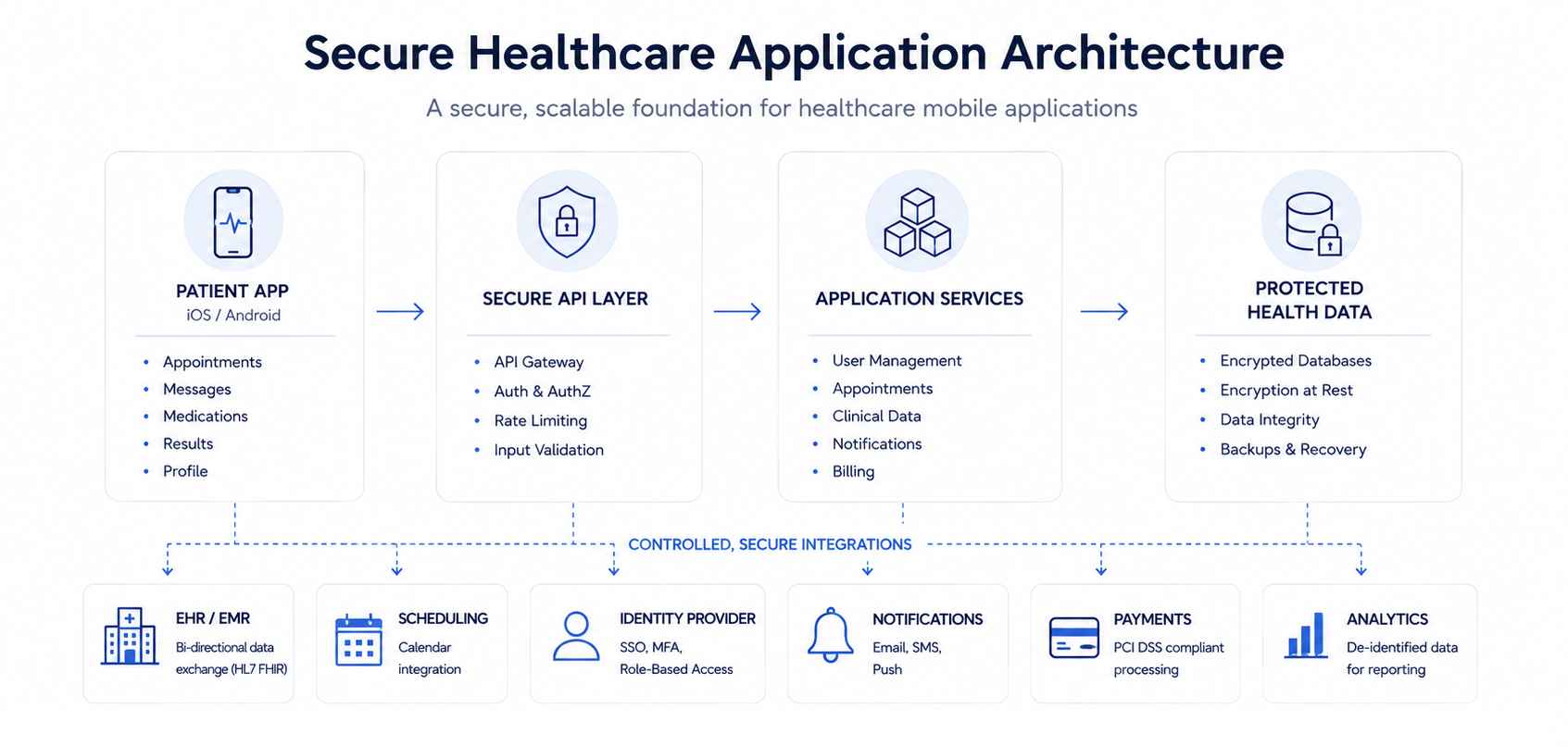

Healthcare digital transformation is no longer limited to replacing paper records with digital systems. Providers are connecting patient portals, mobile applications, telehealth, electronic health records, remote monitoring, payments, and clinical workflows into increasingly integrated ecosystems.
That connectivity creates opportunities for better access and more efficient care, but it also raises the technical stakes. A failure in healthcare software can expose sensitive information, interrupt important services, or create regulatory consequences.
For organizations investing in healthcare mobile app development, security, compliance, and architecture therefore cannot be treated as tasks added shortly before launch. They need to influence product decisions from the beginning.
Start With the Data, Not the Feature List
Before choosing technologies or designing screens, teams should understand what information the product will collect, where it comes from, where it travels, and who needs access.
A scheduling application and a remote monitoring platform may both be healthcare products, but their risk profiles can be very different. The latter may continuously receive physiological data, integrate with clinical systems, and expose information to multiple user roles.
Mapping these flows early helps identify where sensitive information exists and which systems, vendors, and integrations interact with it. It also prevents a common mistake: building functionality first and trying to make the resulting system compliant afterward.
Compliance Depends on the Product and Market
There is no universal “healthcare compliant” technology stack.
Requirements depend on geography, business model, data processed, and the relationship between the software provider and healthcare organization. In the United States, for example, HIPAA applies to covered entities and business associates rather than automatically to every health application.
The practical implication is important: compliance requirements should be identified during discovery, not assumed from the label “health app.”
Teams should determine which regulations apply, what information is protected, where data may be stored, which third parties can access it, and what contractual requirements exist.
Build Security Into the Architecture
Security is stronger when it is structural rather than dependent on developers remembering a checklist.
A healthcare platform should establish clear boundaries between the mobile interface, APIs, application services, databases, third-party integrations, and clinical systems. Each component should receive only the access it actually requires.
Authentication and authorization are particularly important. A patient, physician, nurse, administrator, and support employee should not automatically have access to the same information simply because they use the same platform.
Security architecture should therefore consider access controls, authentication, encryption, auditability, data integrity, and secure transmission from the beginning.
Design for Traceability
Healthcare systems often need to answer questions ordinary consumer applications rarely face.
Who accessed a record? What was changed? When did it happen? Which system initiated the action?
That makes auditability an architectural requirement.
Important events should be logged so organizations can investigate activity without exposing additional sensitive information through the logs themselves. Monitoring can also help teams identify unusual access patterns and operational problems.
This should extend to administrative interfaces. Internal dashboards may contain more information than patient-facing applications, making poorly protected back-office tools an important security risk.
Be Selective About Third-Party Services
Modern applications depend on external tools for analytics, notifications, crash reporting, customer support, payments, and other functionality.
In healthcare, every integration deserves additional scrutiny.
Teams need to understand what data leaves the application, whether identifiers are included, how vendors process that information, and whether each integration is appropriate for the regulatory environment.
This is especially relevant for analytics and tracking technologies. A tool that appears harmless in a conventional consumer app may introduce privacy or compliance concerns when it receives information connected to a patient’s identity or healthcare activity.
The goal is not necessarily to minimize integrations, but to ensure every integration has a defined purpose and controlled data flow.
Prepare Architecture for Interoperability
Healthcare products rarely exist independently for long.
A patient application may eventually need to exchange information with EHRs, laboratory systems, pharmacies, wearable platforms, scheduling tools, or insurance infrastructure. Building every possible integration during an MVP would be wasteful, but ignoring interoperability can make expansion unnecessarily expensive.
Well-defined APIs and modular services make it easier to introduce new connections without rewriting the entire product.
They can also help isolate sensitive functions. Authentication, clinical data, notifications, billing, and analytics do not need to evolve as one tightly coupled system.
Security Continues After Launch
Passing a security review before release does not make a healthcare product permanently secure.
Dependencies change, vulnerabilities are discovered, infrastructure evolves, and new features create new attack surfaces.
Teams therefore need ongoing dependency management, security monitoring, access reviews, backups, incident-response procedures, and regular reassessment of risk. Known vulnerabilities should be patched, unnecessary services removed, and permissions reviewed as the organization and product evolve.
Security becomes an operating process rather than a one-time development milestone.
Digital Transformation Needs a Strong Technical Foundation
Healthcare organizations understandably focus digital transformation initiatives on visible outcomes: easier patient access, faster workflows, better communication, and more connected care.
But those experiences depend on decisions users never see.
Data architecture determines where sensitive information travels. Access models determine who can see it. Integration choices determine which external systems receive it. Monitoring determines whether suspicious activity can be detected.
The strongest healthcare products treat security, compliance, and architecture as interconnected parts of product strategy. Doing so does more than reduce regulatory risk. It creates a technical foundation capable of supporting new integrations, users, and services as the product grows.