

In many industries, trust is established by means of a street address on Main Street, in local branches, and via endorsement by friends and family. When it comes to the financial services industry, a large part of its business is conducted online, and so much of that happens before the actual customer sets foot in a physical branch.
It’s funny how things have changed lately. I recently helped a friend shop for mortgage rates, and we researched everything on the computer together over a cup of coffee and some discussion.
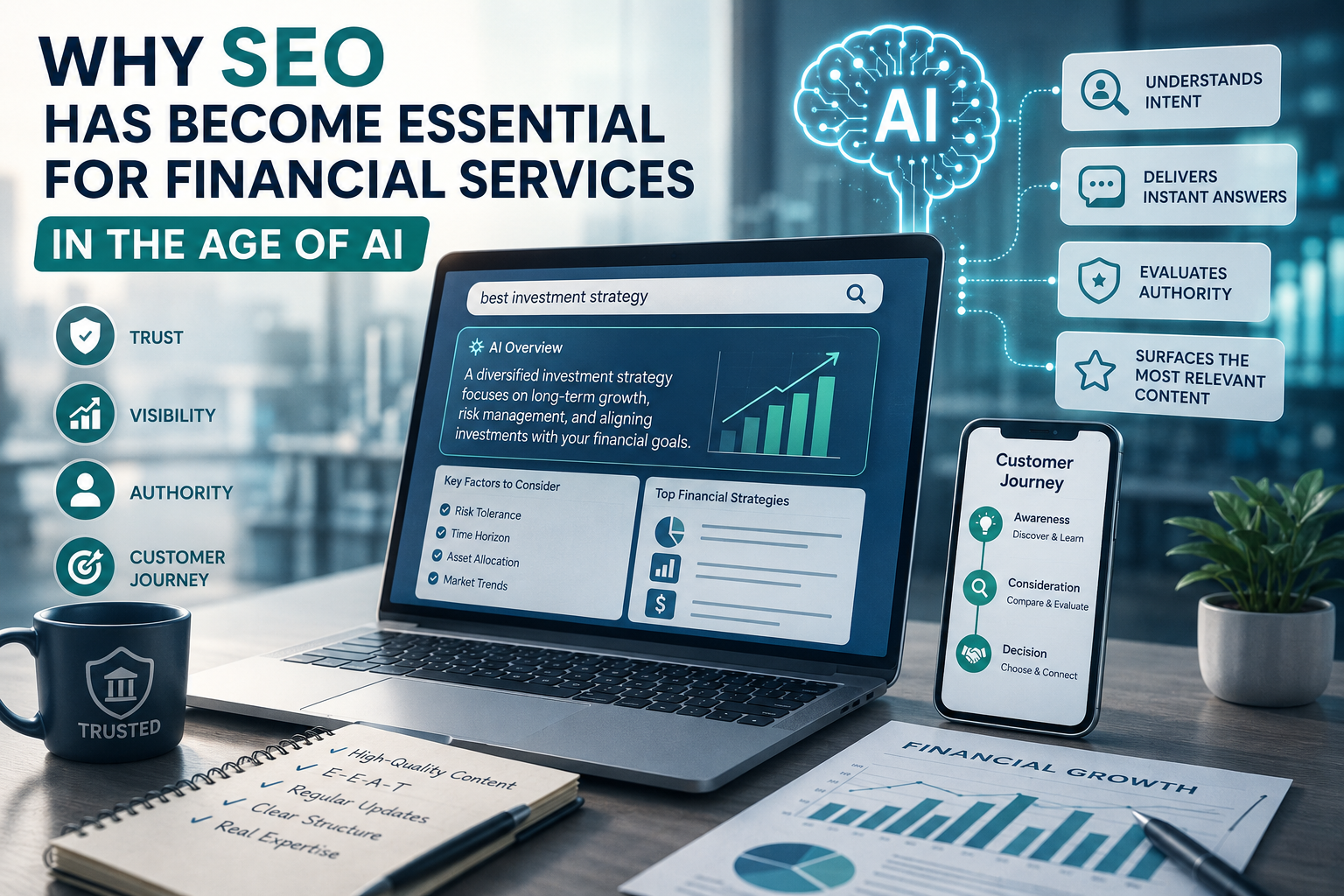
For quite some time, Search Engine Optimization for financial services meant working with the basic search results. But since AI took center stage, online searches have changed dramatically. A search query today brings not the usual ten blue links, but a summary of a huge topic or the direct answer to a search query. By using artificial intelligence in processing searches, search engines also use it to evaluate information online on the basis of a very thorough understanding of context.
Search engines are constantly evolving, and the way Search Engine Optimization (SEO) needs to be approached has changed dramatically in recent years. A long time ago, in internet years, SEO involved adding a couple of keywords to a webpage and trying to get that page to the top of search engine results pages (SERPs) for those keywords.
SEO for financial services is no longer about ranking for a few keywords here and there. The aim of SEO is to establish the authority of a financial service provider’s online presence, signal value to potential customers, and ensure visibility when people search for financial information in an increasingly AI-powered search environment.
The Changing Shape of Digital Search
A while back, I discussed the basics of SEO for websites looking to rank for the most relevant search terms for the products and services they offer. While elements such as links, keyword usage, and relevant content still play crucial roles, the way search engines process and rank results has become significantly more sophisticated.
For decades, search engines crawled online content and indexed web pages primarily based on keywords. Today, they first determine the intent behind a user’s search, often referred to as search intent or query intent.
For example, when someone searches for “Market Volatility” or “Best Investment Strategy,” search engines understand that the user is looking for guidance rather than simply matching keywords. They evaluate available content and determine which pages provide the most complete and relevant answers.
Results are now delivered instantly, often with AI-generated summaries that eliminate the need to browse multiple pages.
If a financial service provider fails to maintain an up-to-date, search-optimized website, it risks being overlooked in favor of competitors producing more useful, authoritative content.
Why Financial Information Demands Higher Authority
Financial information directly affects people’s livelihoods, security, and future. Because of this, search engines apply much stricter quality standards to financial websites than to many other industries.
As AI-powered search systems interpret content, websites must demonstrate that they are reliable sources of financial expertise. Content should be current, accurate, professionally written or reviewed, and organized in a way that AI systems can easily understand and summarize.
Clear Author Credentials
Search engines want to know who created the financial information they are presenting. Content written or reviewed by qualified financial professionals carries greater credibility.
Up-to-Date Information
Financial regulations, interest rates, investment markets, and tax laws change constantly. Content covering these topics should be reviewed and updated regularly to remain useful.
Comprehensive Coverage
The more thoroughly a topic is covered, the stronger the signal that the website is an authoritative resource.
Well-Structured Content
Clear headings, logical organization, and concise summaries help both readers and AI-powered search systems understand content more effectively.
Building and maintaining a trusted financial website requires consistent effort and expertise.
Publishing high-quality financial guidance on a regular basis teaches search systems that your website is a dependable resource. Because search technology and financial regulations evolve rapidly, many organizations choose to work with a qualified fintech SEO agency to maintain that standard.
Standing Out in an Automated Landscape
The internet has become flooded with AI-generated financial articles covering the same topics. Many provide only surface-level information and fail to offer meaningful guidance.
People searching late at night for answers to important financial questions are rarely looking for generic advice. They want practical, detailed information tailored to their specific situations.
Whether someone wants to understand how changing interest rates may affect their local housing market or how new tax legislation could influence succession planning, generic content is unlikely to provide satisfying answers.
Financial institutions that consistently publish practical, in-depth guidance will naturally stand apart from the growing volume of automated content online.
Ultimately, successful SEO is about creating the most valuable resource available for the people searching for answers.
Capturing Intent Across the Entire Customer Journey
Choosing a financial service provider is rarely an immediate decision. Research often takes months or even years, with users searching for different types of information throughout the process.
A successful SEO strategy supports every stage of that journey.
Early Awareness
A prospective client may begin by searching for information about saving for a child’s college education or planning for retirement.
Consideration
As research continues, users compare different financial solutions, such as retirement account types, advisory fee structures, or investment approaches.
Decision
Eventually, users begin evaluating individual financial firms by reading reviews, comparing services, and looking for contact information.
Financial institutions that optimize content for every stage of this journey are better positioned to build trust long before a potential customer reaches out.
Future-Proofing Your Digital Presence
Search technology will continue evolving through AI, voice search, and increasingly interactive experiences. However, one principle is unlikely to change: search engines will continue rewarding content that genuinely helps people.
Future-proofing your SEO strategy means building a framework that can evolve alongside new technologies while consistently producing accurate, trustworthy, human-focused content.
Businesses that invest in high-quality information today will remain visible tomorrow, regardless of how search interfaces continue to change.
Every client relationship starts somewhere. For most financial services firms, that first interaction begins with an online search. Ensuring that your website can be found, trusted, and understood by both users and AI-powered search systems is no longer optional. It is essential for attracting and serving future clients.