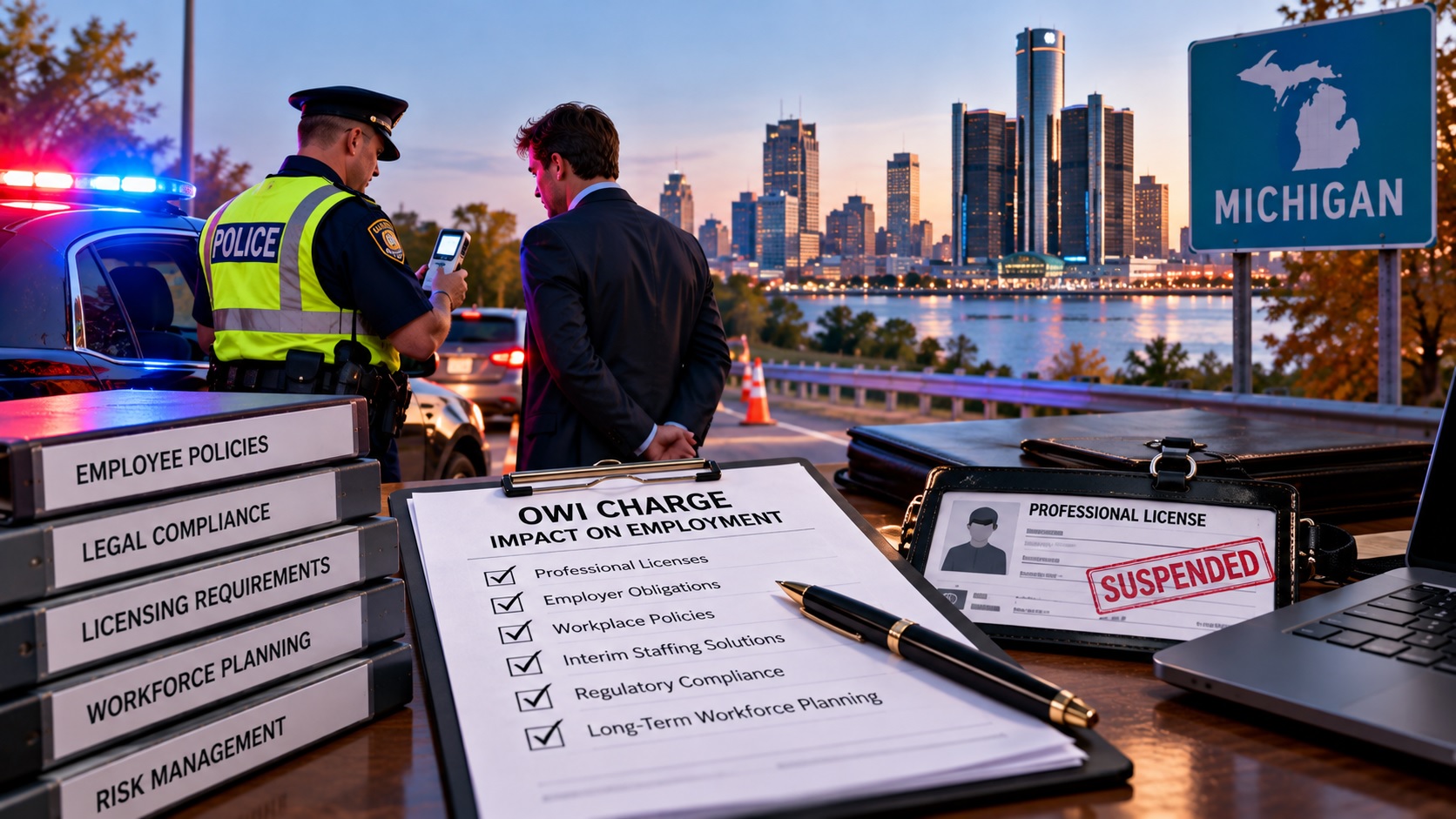

A professional-services business can remain financially healthy yet become unexpectedly vulnerable when a licensed employee faces a criminal allegation. If an employee is arrested for operating while intoxicated (OWI), management must decide what, if anything, has changed about the person’s ability to work without prejudging the criminal case. In Michigan, the answer requires more than checking the next court date. The criminal proceedings, any driver’s-license action, and professional licensing oversight operate under different rules. For employers, knowing which process affects which responsibility is the foundation of a fair and workable response.
A License Is Part of the Business’s Capacity
In a licensed profession, workforce planning is not simply a matter of filling a vacant shift. Some tasks must be undertaken or supervised by appropriately credentialed individuals. That risk warrants accurate credential records, cross-coverage arrangements and clarity about which services require specific qualifications. An OWI charge does not automatically suspend a medical, pharmacy or other professional license. Management should distinguish the employee’s current license status from speculation about future disciplinary action. Decisions affecting patient or client safety must rest on the responsibilities of the position and reliable information, not workplace gossip.
Three Legal Processes, Not One
The first process is the criminal case. An employee researching criminal attorney kalamazoo services may be seeking representation in a local criminal proceeding; the employer should not attempt to direct the defense or assume that a charge will result in conviction. The second process concerns driving privileges, which may be affected by particular licensing sanctions or administrative actions. The third concerns the professional regulator responsible for the individual’s credential. A criminal disposition may become relevant to a licensing review, but the two processes are not interchangeable. A business should establish which body actually controls the authorization it needs to verify.
The 30-Day Conviction Rule Requires Precision
Michigan Public Health Code Section 333.16222(3) requires covered health-profession licensees and registrants to notify LARA of any criminal conviction within 30 days after the conviction date. The section also provides for administrative action when that notification is not made. The wording matters: the cited statutory duty concerns a conviction, not a universal 30-day notification obligation triggered by every arrest. Nor should that rule be applied automatically to unrelated licensed occupations whose requirements may differ. HR should communicate what its own policy actually says, identify an appropriate contact for confidential reports and avoid announcing a regulatory breach before establishing the relevant facts.
A Driver’s-License Deadline Can Arrive First
For some Michigan chemical-test refusals, a person who receives an officer’s notice of suspension has 14 days to request an implied-consent hearing. This is not a general 14-day deadline for every OWI arrest; it concerns the statutory refusal procedure and its notice requirements. The consequences for work can be practical and immediate. Management should verify what activities are legally permitted and consider whether duties can be reassigned or appointments covered. General information about the defense process is available through https://mmldefense.com/kalamazoo-dui-owi-defense-attorney, while decisions about a specific person’s licensing position require review of the actual notice and qualified advice.
Employment Fairness and Credential Verification Must Coexist
Federal employment guidance makes an important distinction between arrest and conviction records. The Equal Employment Opportunity Commission explains that an arrest by itself does not establish criminal conduct; using criminal-history information for employment decisions can raise Title VII concerns in some circumstances. A valid license may establish authorization to perform regulated work, but it does not settle every employee-safety question; conversely, an arrest alone does not establish that the person can no longer perform licensed duties. Michigan businesses can establish an internal process that begins by checking whether the employee’s credential remains active and whether any known restriction affects essential duties.
Managers should ask for information reasonably necessary to administer workplace requirements, protect appropriate confidentiality and consult counsel when disciplinary action is contemplated.
When a Regulatory Inquiry Becomes a Separate Matter
LARA’s professional licensing complaint process can involve initial screening, investigation and, where warranted, disciplinary proceedings. A complaint does not guarantee discipline, and any administrative outcome depends on the governing law, the evidence and the regulator’s procedures. A licensee may encounter information described as when seeking advice about an administrative investigation. Where the regulator requests information, the business should provide accurate records through appropriate channels rather than attempting to shape the employee’s account or withhold lawfully required material.
Recovery Resources Are Not Automatic Disciplinary Measures
Michigan’s Health Professional Recovery Program is a confidential, non-disciplinary program intended to assist eligible licensed or registered health professionals dealing with substance-use or mental-health-related impairment. Participation and confidentiality depend on the program’s rules and circumstances; an employer should not imply that an OWI arrest establishes a substance use disorder or makes enrollment mandatory. Organizations must respect their regulatory responsibilities while avoiding unsupported medical conclusions, and any support pathway should align with the actual requirements of the role.
Plan for Service Continuity Without Predicting the Verdict
A sensible contingency plan identifies credential-dependent services, delegates appropriate scheduling decisions and maintains up-to-date contact information for authorized professionals. If an employee cannot drive, management may need to rearrange travel-based assignments; if a professional license is formally restricted, the company may need a different staffing response. Businesses that verify current authorization, apply employment policies consistently and separate independent legal advice from operational decisions can protect continuity without assuming guilt. The outcome is a more resilient licensed workforce and a fairer response when uncertainty affects someone whose qualifications the company relies upon.