
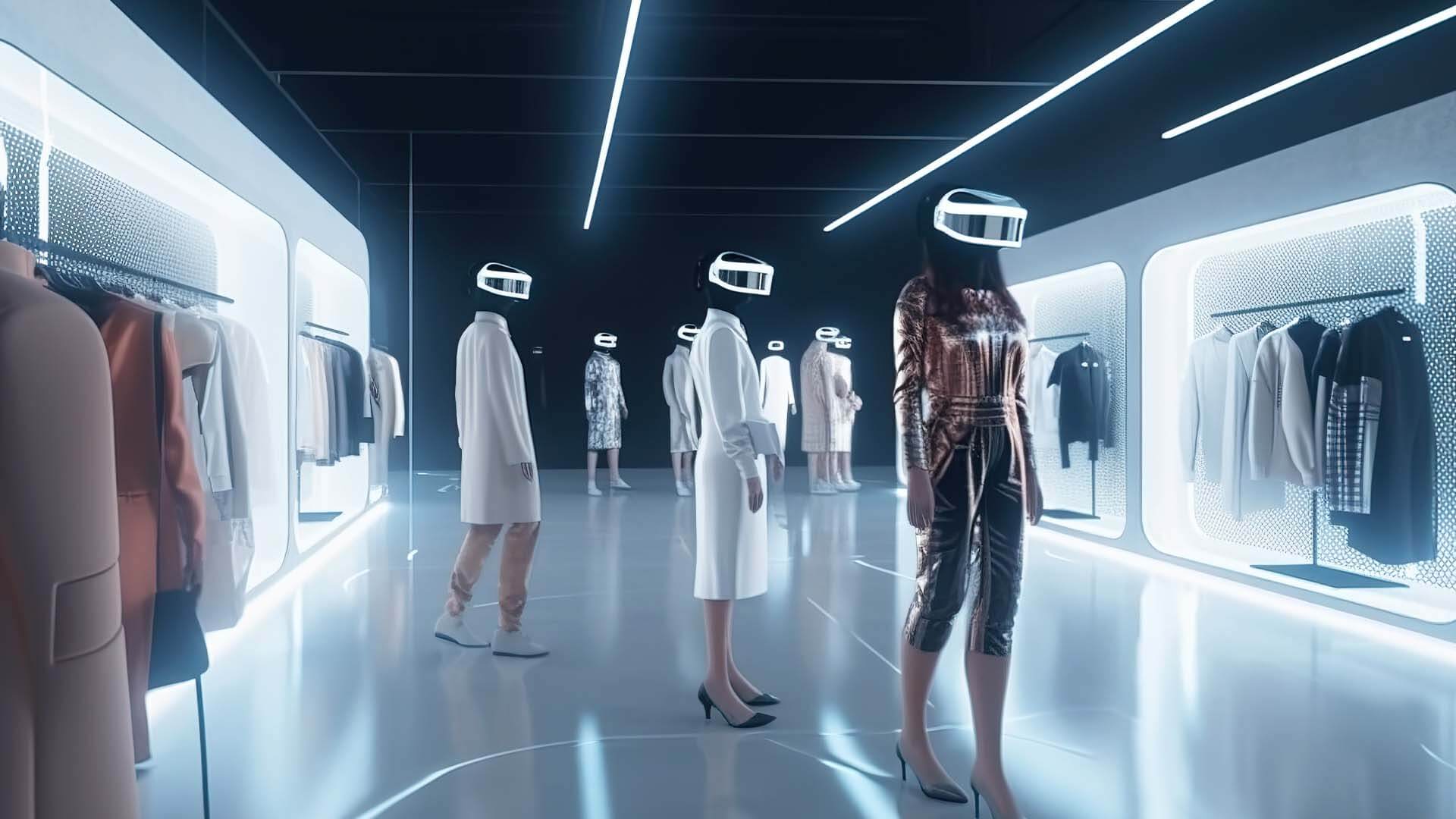
Each year, the number of customers ready to make purchases with VR is growing, even in the premium segment of the retail market. According to June 2022 Global Consumer Insights Pulse Survey by PWC, 19% of consumers used VR to purchase luxury goods.
Retailers can benefit from this trend by adopting VR in their technical stacks. By providing a VR-based shopping experience, retailers can stand out among competitors and build stronger customer relationships, increasing sales.
View some real-life examples of VR in retail and learn how to transform customer experience with VR, boosting your retail business performance.
Augmenting traditional retail with VR
In the simplest scenario, a retailer can adopt VR technology to complement existing consumer experiences rather than transform them completely. For example, a retailer can improve specific aspects of traditional shopping, such as try-on, to make it more engaging and convenient.
A retailer can implement a virtual showroom, an immersive environment designed to showcase products or services, and build it into a physical store.
Using a virtual showroom, customers can try on products in VR-based environments. For example, a visitor to a furniture store can use VR to see how this or that product would look in a different design or configuration.
According to PWC, 32% of consumers purchase products as a result of testing them with VR. Adopting such a virtual showroom today seems a natural step for any enterprise aiming for digital retail transformation.
Example:
Natuzzi, an Italian furniture manufacturer and retailer, has adopted technologies such as AR and VR to provide outstanding customer experience. In 2019, Natuzzi opened its first augmented store where every visitor could wear a Microsoft HoloLens helmet and enter a virtual showroom.
There, customers could view the retailer’s entire product catalog, which allowed Natuzzi to free up space in its physical Store. In addition, customers could customize certain pieces of furniture, experimenting with color, textures, and materials. VR capabilities allowed the retailer to simplify the sales process on the one hand and make it more engaging on the other.
Among other things, the retailer used VR to personalize customer service. Using photographs and CAD files, the retailer recreated real customer interiors in a virtual environment. Now visitors to the augmented store could try out furniture and designs in their digitally rendered homes, leading to even deeper emotional engagement.
Establishing a virtual store
A retailer can use 3D images with 360-degree coverage and turn its ecommerce website into a virtual store, thus providing customers with the best-of-breed online shopping experience. Customers can navigate such a virtual store via web browsers on their desktops or smartphones, view products, and even purchase them.
Implementing a virtual store can benefit the retailer in many ways. On the one hand, such a store works as an additional sales channel for a younger audience and people already familiar with VR. On the other hand, such a store can provide retailers with valuable data on consumer behavior, which can be helpful from an analytics perspective.
Example:
In 2022, a US-based department store chain Bloomingdale’s opened a virtual store to celebrate the brand’s 150th anniversary. Expanding the brand’s audience was one of the project’s primary goals; by implementing a store, the enterprise could fulfill this goal and reach a younger customer segment.
By clicking on the floor of a virtual store, customers could travel through VR showrooms that featured collections from brands including David Yurman, Baccarat, and Polo Ralph Lauren. In addition, customers could interact with the products displayed in the virtual rooms to gain more information or add them to a cart and then purchase.
Running VR-based marketing campaigns
Considering that VR technology enables effective customer engagement, it would be amiss not to use it for marketing purposes. Retailers can use VR to augment their traditional marketing activities or launch fully immersive virtual campaigns depending on their business needs.
Example:
In recent years, we have seen many examples of retailers using VR-based marketing. For instance, we can recall Adidas, a sportswear manufacturer and retailer that launched a VR-powered marketing campaign to promote TERREX, a line of outdoor accessories and apparel.
Adidas has partnered with marketing agency Somewhere Else to recreate the climbing of Ben Rueck and Delaney Miller, two extreme sports professionals, in a virtual environment. Using a VR headset and touch controls, customers could follow the climbers’ path and participate in the ascent, thus gaining an amazing digital experience.
Creating a metaverse
The most innovative and future-oriented retailers who aim to stand out from the competition can consider creating their own metaverses. A metaverse is a full-fledged digital world or even several connected and interoperating virtual worlds.
As an option, a retailer can create a chain of interconnected virtual stores that provide different tailored experiences and cover diverse audience segments. In addition, implementing a flexible and scalable architecture like MACH can come in handy since it enables the launch of new marketing channels (like metaverse) quickly.
Example:
Gucci, an Italian luxury fashion house, has built its own metaverse with The Sandbox platform. The metaverse included Gucci Vault Land – a virtual space where customers could play games, interact with non-player characters (NPCs), and learn the brand’s story with vintage NFTs.
Final thoughts
Several years ago, virtual reality penetrated the retail market, and early adopters started implementing VR in their technical stacks, thus gaining a competitive edge. Today, increasingly more retailers are considering VR adoption to transform traditional retail and provide outstanding customer experience.
While some retailers are just starting to augment traditional retail activities with VR, others are building full-fledged virtual stores and running powerful VR marketing campaigns. At the same time, the most ambitious market players initiate the creation of their own metaverses, aiming to maximize customer engagement.