
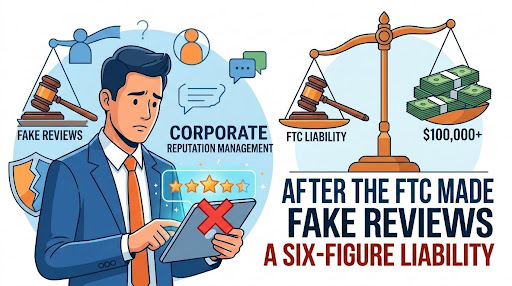

A single fake review could now cost your company six figures in FTC penalties. The FTC’s 2024 rule has transformed deceptive review practices into a serious financial liability, threatening corporate reputation management overnight. Understanding the key provisions, fine structures, and compliant strategies for authentic reviews is no longer optional for businesses operating at scale.
What the FTC’s 2024 Rule Actually Covers
The FTC’s 2024 rule imposes fines of up to $50,120 per fake review to target review fraud and astroturfing under Section 5 of the FTC Act. Fake reviews are any consumer reviews that misrepresent the reviewer’s identity, experience, or independence.
The Five Practices Now Explicitly Banned
The rule prohibits five specific practices under 16 CFR 425.2, which states sellers “shall not create, purchase, or write fake consumer reviews.”
- Creating fake reviews: Employees posting as customers, known as sockpuppeting, violates undisclosed endorsement guidelines.
- Buying or suppressing reviews: Platforms like Fiverr offer bulk review packages that directly violate the ban on procuring fake endorsements.
- AI-generated reviews: Tools producing scripted reviews at scale are banned as artificial consumer-product interfaces.
- Review gating: Email campaigns that instruct customers to “only share if you’d give us 5 stars” suppress honest feedback, which is explicitly prohibited.
How the Fine Structure Works
The base fine is $50,120 per violation, adjusted for 2024. 100 fake Google reviews equal $5.01 million in potential exposure. Penalties multiply for repeat offenses, and disgorgement of profits can be added on top.
| Violation Type | Per Violation Fine | Total Paid |
| Fake home service reviews | $50,120 | $7.8M (HomeAdvisor, 2022) |
| Suppressed fashion reviews | $50,120 | $4.2M (Fashion Nova) |
| Cannabis product reviews | $50,120 | $17.5M (Curaleaf) |
| 100 fake reviews | $50,120 x 100 | $5.01M base + disgorgement |
Fifty fake reviews yield $2.5 million in base exposure before injunctive relief is factored in. FTC consent orders often include mandated corrective advertising, which compounds the financial damage.
Corporate Reputation Management: Who Bears Personal Liability
C-suite executives face personal liability under Section 5. Boards risk shareholder lawsuits from oversight failures.
| Role | Exposure Path |
| CISO | Failure in review moderation technology; audit trails expose sockpuppeting |
| CMO | Influencer marketing violations; undisclosed endorsements trigger fines |
| CEO/Board | Oversight of FTC compliance; shareholder suits over reputation damage |
| Compliance Officer | Poor vendor agreements; review gating leads to enforcement |
Building a Compliant Review Collection System
For platform selection, the following options offer strong compliance features:
| Platform | Compliance Score | Cost | Best For |
| Trustpilot | High | $199/mo | E-commerce reputation |
| Yotpo | High | $29/mo | Retail reviews |
| Google Reviews | High | Free | Local SEO |
| Birdeye | High | $299/mo | Service industry |
A practical seven-step collection process for legitimate reviews:
- Send post-purchase SMS 14 days after delivery
- Offer no incentives beyond a $1 thank-you gift card with full disclosure
- Apply auto-disclosures for any rewards
- Moderate for authenticity using platform tools
- Display only verified reviews publicly
- Respond to all feedback promptly
- Audit collections quarterly for FTC compliance
Practices That Trigger Detection Algorithms
Review platforms now use algorithmic detection for FTC-red-flagged patterns. These are the eight practices most likely to surface in an audit:
| Practice | FTC Violation | Fix |
| Review gating emails | Hides negative reviews | Publish all reviews |
| Employee reviews | Undisclosed endorsements | Prohibit staff reviews |
| Fiverr review purchases | Paid for fake reviews | Use verified platforms |
| AI-generated text | Deceptive practices | Human moderation only |
| Family reviews | Undisclosed ties | Require disclosures |
| Competitor suppression | Unfair competition | Focus on your own reviews |
| Star rating pressure | Review fraud | Encourage honest feedback |
| Volume spikes over 300% monthly | Astroturfing | Cap organic growth |
Proactive Monitoring: What Tools to Deploy
Brand24 at $99 per month, combined with ReviewTrackers at $199 per location, monitors 47 platforms with real-time FTC violation alerts. That combination gives businesses early warning on the patterns that draw regulatory attention.
Firms like NetReputation have built monitoring workflows that integrate these tools with CRM systems for automated escalation when thresholds are crossed.
| Tool | Platforms Monitored | Price |
| Brand24 | 47 platforms | $99/mo |
| ReviewTrackers | Multi-location | $199/location |
| Reputation.com | 50+ sites | $299/mo |
| Podium | SMS-integrated | $499/mo |
| Birdeye | 200+ platforms | $299/mo |
| Mentionlytics | 100+ sites | $99/mo |
Five Steps to Implement Monitoring
Assess platforms: Identify top review sources for your industry. Prioritize by volume and impact on star rating.
Select and subscribe: Start with Brand24 or Mentionlytics for broad coverage, then add ReviewTrackers for location-specific data.
Configure API integrations: Link your CRM and Google My Business to enable centralized data flow.
Set alert thresholds: Define review velocity above 50 per day as high-risk. Customize for sentiment patterns linked to undisclosed endorsements.
Test and train: Run simulations of review fraud scenarios. Train compliance officers on alert workflows.
Training and Compliance Programs
Annual training through platforms like ComplianceWire at $49 per user reduces violations, according to SHRM compliance studies. The training covers review authenticity requirements, prohibited practices, and how to recognize astroturfing and sockpuppeting in active review channels.
A complete compliance program includes five components:
| Component | Frequency | Tool | Cost |
| Employee training | Annual | ComplianceWire | $49/user |
| Vendor contracts | Upon renewal | NDAs with FTC clauses | Legal fees |
| Executive briefings | Quarterly | Internal decks | Minimal |
| Review team certification | Annual | Trustpilot Academy | Free |
| Audit trails | Ongoing | Review software | Subscription |
Vendor contracts must include NDAs with specific FTC clauses on review authenticity. These agreements prevent partners from engaging in incentivized reviews or undisclosed endorsements. Quarterly executive briefings should address emerging threats, particularly those related to AI-generated reviews, which pose new detection challenges.
Measuring Reputation Health with KPIs
Five KPIs give a clear picture of where a company stands on review integrity:
- Reputation Score: Target 80 or above; low scores flag fake review risks
- Review Velocity: Target 15 or more per month; spikes indicate potential gating or sockpuppeting
- Sentiment: Target 75% positive; negative shifts can expose undisclosed endorsements
- Share of Voice: Target 40% or higher in key channels
- FTC Risk Score: Target below 5; calculated from suspicious review patterns and compliance gaps
Calculate the FTC Risk Score weekly by weighing suspicious review patterns against active compliance gaps. Review it alongside velocity and sentiment data. That combination gives compliance officers and executives the clearest picture of where liability is building before it becomes an enforcement action.