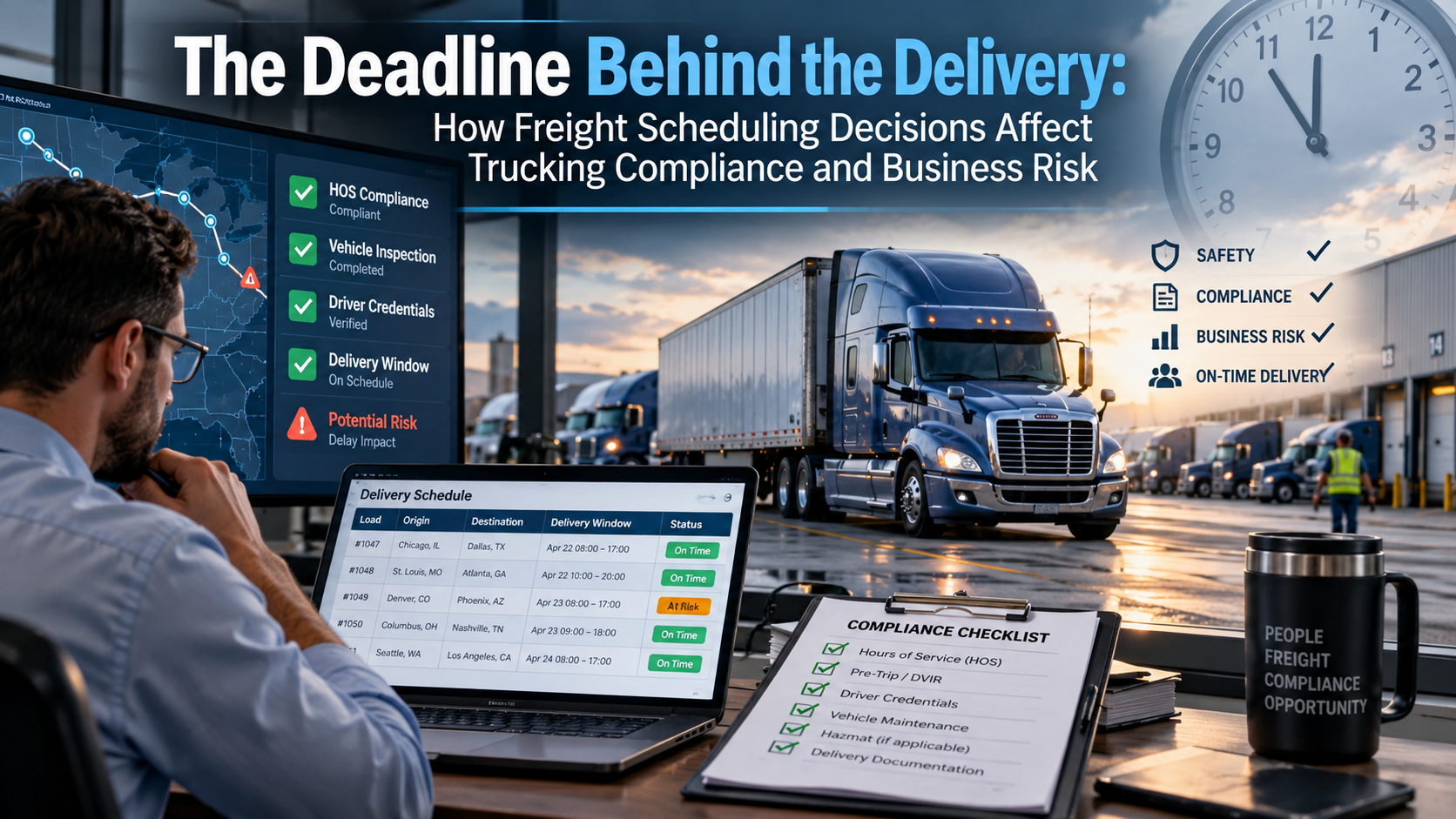

For businesses that depend on freight transportation, an on-time delivery is often treated as evidence of operational success. When the schedule leaves little room for adjustment, the consequences can affect far more than one shipment. Although carriers and drivers have specific regulatory duties, freight customers and logistics intermediaries also influence the conditions under which transportation services are delivered.
Why Freight Scheduling Is a Corporate Management Issue
Freight transportation is rarely controlled by one business. Commercial difficulties arise when those decisions are made independently. A procurement team may negotiate a narrow delivery window without confirming realistic transit requirements. Accurate estimates should account for distance, loading arrangements, expected waiting periods and the regulatory limitations governing the driver.
Understanding the Federal Hours-of-Service Framework
The Federal Motor Carrier Safety Administration establishes hours-of-service requirements for covered commercial drivers through Title 49, Part 395 of the Code of Federal Regulations. Drivers must also take a qualifying 30-minute interruption after accumulating eight hours of driving without such an interruption. They affect how transportation businesses calculate delivery capacity, allocate assignments and respond when operations do not proceed as expected.
The Difference Between Driving Time and Working Time
One of the most significant planning mistakes is treating the time a driver spends behind the wheel as the only relevant measure. The fact that a vehicle is stationary does not automatically mean the driver’s regulatory clock has stopped. A schedule that was compliant when initially planned may require revision after unexpected loading or unloading delays.
Loading-Dock Delays and Their Wider Business Consequences
Loading and unloading operations are frequently managed separately from transportation scheduling. The consequences can extend to other facilities, customers and transportation providers. Consider a hypothetical manufacturer that schedules a shipment from Arkansas to a customer in Louisiana. Pressuring the driver to recover that time through an unsafe or unlawful schedule would not resolve the underlying planning problem.
Improving Coordination Between Warehouses and Carriers
Businesses can reduce avoidable disruption by improving communication before vehicles arrive. Transportation reliability is ultimately influenced by the performance of the entire supply chain, not simply the speed of the vehicle carrying the goods.
Driver Coercion and the Responsibilities of Commercial Partners
Federal regulations recognize that inappropriate pressure on drivers may come from parties beyond their direct employers. Under 49 CFR Section 390.6, motor carriers, shippers, receivers and transportation intermediaries are prohibited from coercing commercial drivers to operate in violation of specified federal regulations. For corporate procurement teams, the regulation highlights why supplier relationships should not reward disregard for safety requirements.
Electronic Logging Devices and Operational Transparency
Electronic logging devices have changed how many commercial carriers record drivers’ working and driving periods. Covered drivers generally must use compliant ELD systems unless a regulatory exception applies. Under federal rules, carriers generally must retain drivers’ records of duty status and the required supporting documents for six months. ELD records also have specific backup and privacy requirements.
Using Records to Improve Performance
These records have value beyond regulatory inspections. The objective is to use reliable operational evidence to improve scheduling decisions, while respecting the legal requirements governing recordkeeping and employee information.
When a Serious Collision Raises Questions About the Schedule
A serious commercial vehicle collision can bring attention to the operational decisions made before a shipment began. Determining causation requires consideration of the available evidence and applicable law. Businesses operating through Arkansas may encounter these questions when claims involve local or interstate carriers. Legal practices such as Rice & Kendig handle truck accident matters in which transportation records and the circumstances of a collision may require detailed examination.
Louisiana’s 2026 Comparative-Fault Change
Commercial transportation companies operating in Louisiana should also understand that state law may affect how responsibility is assessed following an injury-producing collision. Effective January 1, 2026, Louisiana amended Civil Code Article 2323 to introduce a modified comparative-fault framework. A Louisiana personal injury attorney evaluating a particular matter may therefore examine both the factual basis of the collision and the applicable state’s legal framework.
The Commercial Value of Realistic Carrier Agreements
A freight transportation contract should establish more than a price and delivery destination. The agreement should not promise that a carrier can perform a service in circumstances that would require a violation of applicable regulations. Businesses should work with qualified advisers to develop terms appropriate to their operations. A commercially effective arrangement also encourages early communication.
Why Regional Freight Operators Need Coordinated Planning
Arkansas and Louisiana form part of important interstate and regional freight networks, with commercial shipments moving between manufacturers, distribution facilities, ports and customers across state lines. For logistics leaders, this illustrates why reliable documentation, coordinated scheduling and appropriate professional advice should form part of established business practices rather than emergency measures introduced only after a problem.
Making Delivery Reliability a Shared Executive Priority
Transportation reliability is often measured through delivery performance indicators, but those measures should reflect the conditions under which freight services are delivered. Senior management should encourage coordination between procurement, warehouse operations and transportation planning. It may be a better appointment process, clearer communication or more accurate estimates of the time required to complete an assignment.
The Business Case for Safer Freight Commitments
Federal hours-of-service requirements establish important limits on commercial driving, but effective transportation management requires more than knowing the regulations. For business leaders, the objective should be to create a transportation process in which commercial commitments are ambitious but achievable. A dependable supply chain is not built by asking drivers to recover every lost hour.