

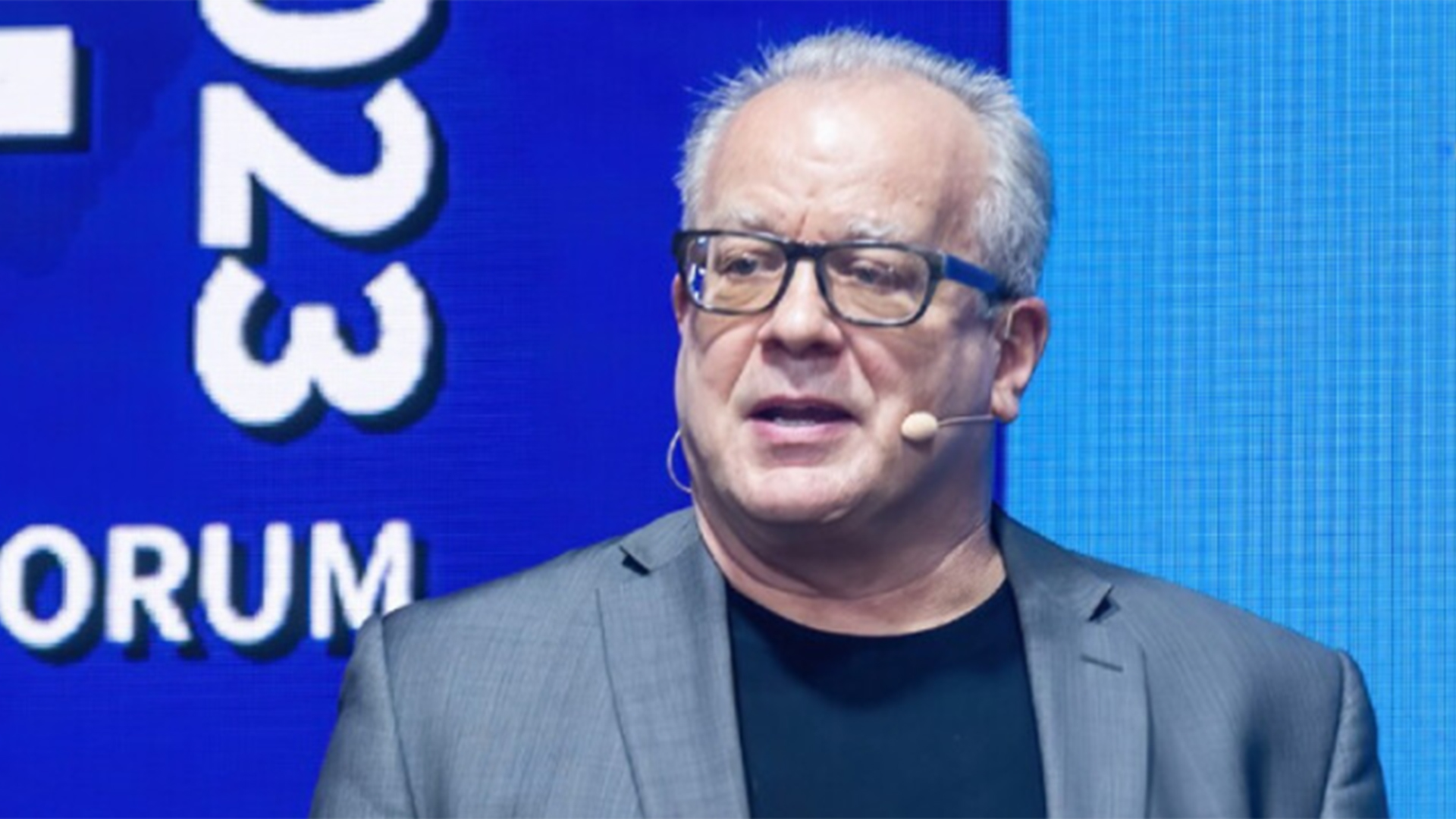
This exclusive interview with Richard Yonck was conducted by Tabish Ali of the Motivational Speakers Agency.
Richard Yonck has spent decades examining how emerging technologies change business, work and human behaviour. The Founder and Lead Futurist of Intelligent Future Consulting, he is a bestselling author, former Computing and Artificial Intelligence Contributing Editor for The Futurist and an international technology speaker specialising in AI, strategic foresight and Emotion AI.
His 2017 book, Heart of the Machine, examined the development and implications of artificial emotional intelligence. He later published Future Minds, tracing the evolution of intelligence and its possible future forms.
In this exclusive interview with the AI Speakers Agency, Richard explains why businesses should use AI to augment employees, how spatial intelligence could change robotics and physical workplaces, and where Emotion AI creates serious privacy questions. He also sets out what leaders must change if AI adoption is to produce genuine transformation.
Question 1. What must leaders understand before shifting from AI as a tool to AI as a collaborative partner?
Richard Yonck: “My belief is that when it comes to any transformational technology, anything that’s really new and disruptive, invariably there’s a transition time.
“It takes time for us to develop the new rules, the new playbook by which we utilise it. Whether we’re talking about the printing press, assembly lines or the computer, we tend to initially want to do things the way that we used to do it for an old process.
“In fact, there are so many new ways and better ways to utilise the new technology to our benefit.
“One of the biggest things when it comes to the new era of AI that we still have to get our head around is that we shouldn’t be using it to replace employees so much as to help augment them, make them able to work in a synergistic way that helps benefit both themselves and the business.”
Question 2. How should leaders redesign work around AI to achieve transformation rather than incremental efficiency?
Richard Yonck: “When we talk about how business and leadership are going to utilise and incorporate AI into their businesses, into their world, it’s, in my mind, less about a replacement technology.
“This is much more of an augmentation engine. It’s something that we can utilise to move our processes forward in so many new ways in terms of how we are creative, how we develop strategy and how we collaborate.
“Rather than thinking in the old terms, utilise it to make our businesses not just more efficient, but actually leap forward, to be able to transform and ideally get ahead of the rest of the competition.”
Question 3. What is spatial intelligence, and how could it change the way AI and robotics operate in physical workplaces?
Richard Yonck: “Spatial intelligence is something that is just coming online. Many people aren’t familiar with the term. It’s been referred to in a range of different ways: embodied intelligence and experiential intelligence.
“We’ve had, for many years now, AI that has incrementally been getting better at being able to work with information, work with data.
“This is a transformation from a system, a form of intelligence that not only interacts with our information, but actually understands our world. This is a big transition.
“We’ve been moving through a period of generative AI that’s been based on text, on information that we’ve been pouring onto the internet for 30 years or more.
“Many people believe that we’re coming to a ceiling for how far that can go. Others believe that it’s just a matter of keep scaling.
“But when you talk to people like Fei-Fei Li of Stanford, who recently started World Labs, or Yann LeCun, who left Facebook AI Research to start AMI Labs, these are basically working towards building a form of spatial intelligence, having systems and AI be able to learn much more like human beings do.
“When we are born, we don’t suddenly have information poured into us. We go out and explore the world. We learn how physics works. We learn how causality works, what we bump into and how we navigate through a space.
“This could change how technology works with business. Rather than seeing our workflows, workspaces and processes in informational terms, we can actually visualise it and incorporate it much more the way that people do.
“That’s powerful and essential if things like robots and cobots are going to work with employees in both a safe and efficient way.”
Question 4. Where could emotion AI improve customer and employee experiences, and what privacy boundaries must leaders protect?
Richard Yonck: “Emotion AI is a broad field, and it has so much potential for altering how we work and experience our environment and the world.
“But it’s a mixed bag because, in many respects, this is technology that touches on the core aspect of what human beings are. Our emotions are one of the most central aspects of our experience.
“Being able to recognise, understand and respond, utilising that information as an interface, is incredibly powerful, but it is also invasive.
“When the initial research was being done, it was fascinating. There was so much potential. But then we start coming into an era where sensors and cameras in the environment and our information and data start becoming something that we have to be careful about, something we want to be held private in many respects.
“It’s a real interesting edge that we have to walk in order to ensure that people are protected, but at the same time that we utilise this technology to benefit how we respond in the workplace, in all kinds of environments and in terms of marketing.”
Question 5. How do you design a keynote so its insights translate into lasting value for the audience?
Richard Yonck: “When I’m on stage, the thing that I want most is for the audience to have the outcome that the organisers initially wanted.
“When I’m starting off with a project, I work with the clients and the organisers to co-create the space, the idea and the messages that we want to get across in order to fulfil what their planned outcomes are.
“Many times, I’ll push it back a little and give them some other ideas from where they thought they were wanting to go, but ultimately this is their show.
“What I want to come off that stage feeling is that people feel inspired. They feel informed. They feel that they have gotten something new that they didn’t have before they walked in there and that, ideally, they’re going to continue to talk about that for weeks or years to come.”