
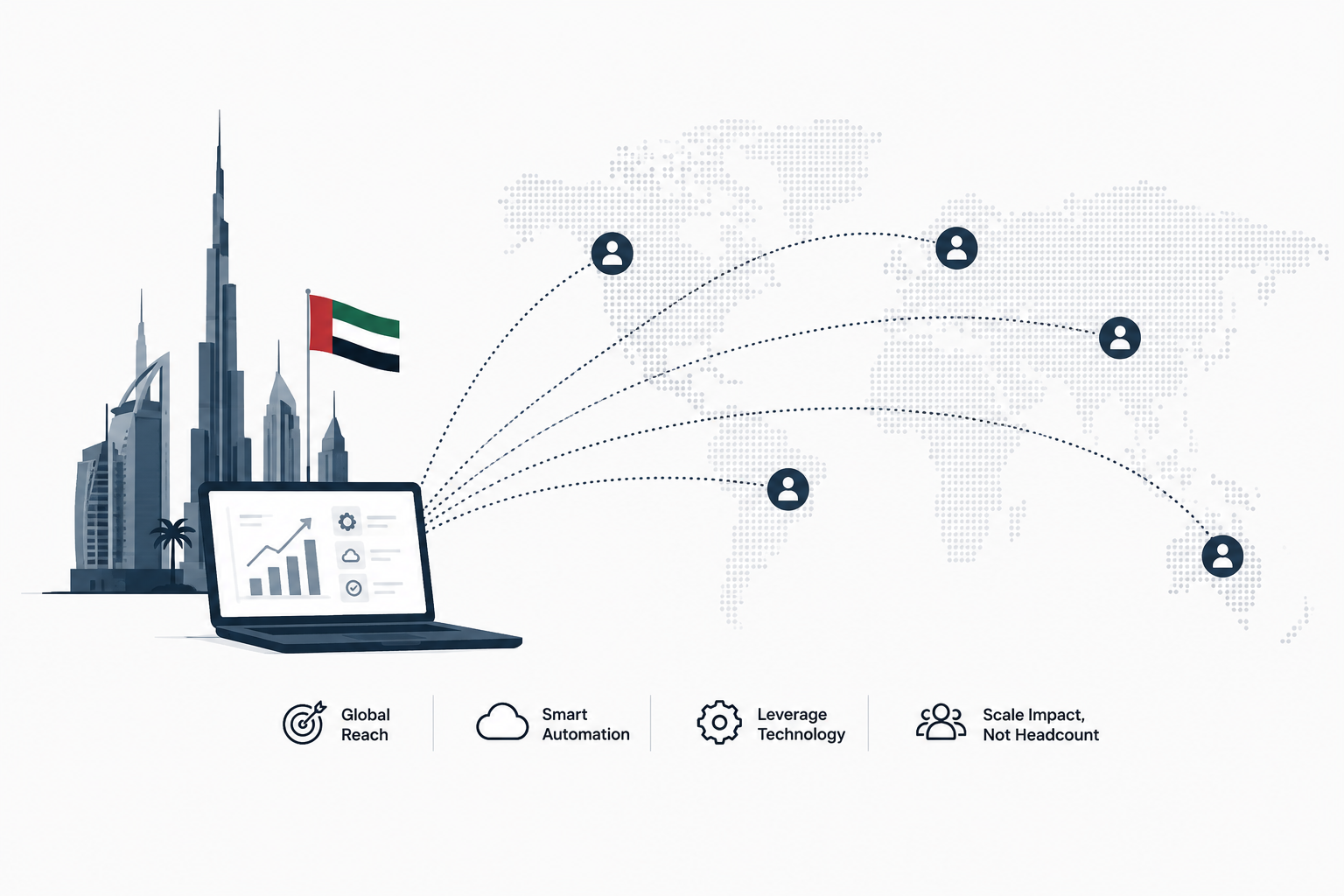

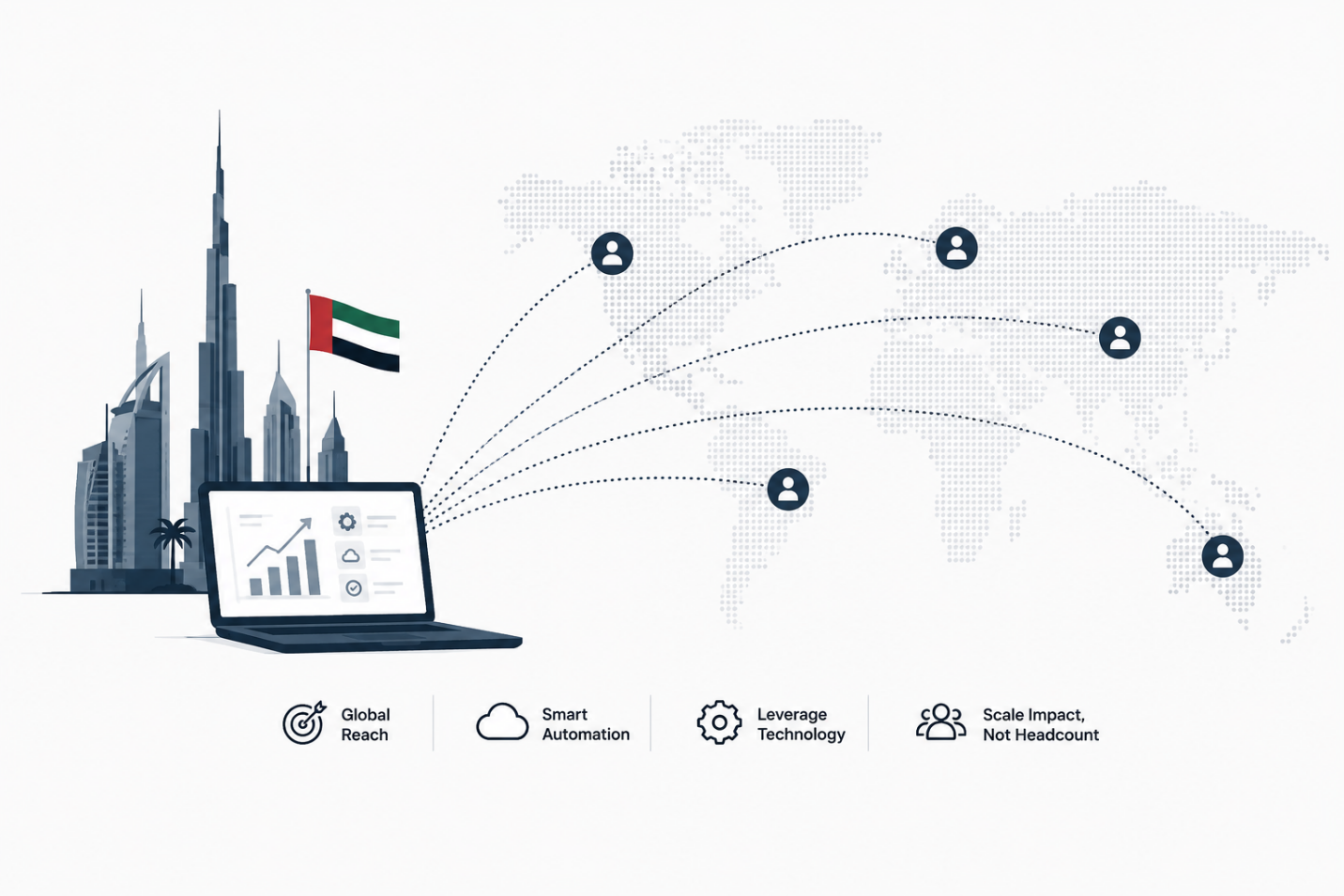
International business development, based on the old rule of thumb, has always been about doubling revenue, doubling the team. This is a major obstacle for a growing number of technology firms in the UAE. Taking on a lot of people on-site across multiple time zones simultaneously creates administrative hassles, increases visa expenses, and causes recruitment lags that can impede progress.
Forward-thinking technical companies in UAE are making a concerted effort to move away from traditional organisational structures in today’s fiercely competitive market. To scale up internationally, they’re not just building bigger, more complicated facilities — they’re using the advanced operational efficiency of tech companies to do it.
The Paradigm Shift: Efficiency vs. Headcount
It is only human nature to want to hire when one’s business is growing. The addition of personnel to address operational needs, however, can come as an added expense of:
- Communication latency. Larger groups need more meetings, alignment sessions, and administrative oversight, which can delay action and inaction.
- Geographical friction. Opening physical offices in new target regions must overcome local labor laws, payroll compliance, and cultural onboarding.
- Onboarding drag. It can take several months for someone to be productive, which takes up precious time from key employees, especially during important growth phases.
A global expansion strategy that is structured and automated, on the other hand, is grounded in a lean operating model. In this configuration, your core team serves as the conductors of automated systems, enabling the business to process much more traffic and customer requests.
Transforming Operations Through Strategic Automation
In order to grow your enterprise’s international reach in tandem with your staff, your internal operations need to run with very little manual handling.
Automating the Customer Journey
In today’s tech world, instead of building support teams on the ground in other time zones, complex service platforms are used:
- Intelligent routing. Guiding incoming client requests to the proper resources, by intent, region, or technical complexity.
- Self-service portals. Supporting international clients to solve technical issues without the help of a representative, using dynamic and interactive knowledge bases.
- Predictive diagnostics. Solve potential problems before they affect the user, and even be able to cut down ticket volumes.
Having these customer interactions automated means a centralised team can service all of their customers across different international markets with the same level of service, without the need for regional support desks.
Leveraging AI for Lean Global Scale
Artificial Intelligence has transformed from a theoretical concept to an integral part of the corporate growth strategy for sustainable business growth. AI integrations enable lean teams to operate with efficiency on par with organisations that are many times their size when done right.
Ideas for high-impact AI applications for lean teams:
- Predictive business intelligence. Real-time insight into international market trends and customer behavior. This assists executives with making decisions on product allocation and marketing expenditure using data.
- Hyper-localised marketing. Instantly localise product messaging, product documentation, and digital assets for new regions. This enables a slim marketing group to run multi-country marketing campaigns without coordinating with many regional marketing agencies.
- Automated lead generation. Using automated outreach tools to find, qualify, and reach out to high-value international leads, allowing sales directors to dedicate resources to closing high-value accounts.
The effective integration of these AI-powered workflows can give your current specialists a boost in productivity, enabling them to run wide-ranging, global campaigns with ease.
Designing a Modern Architecture for Growth
A scalable international growth strategy requires a technical foundation built for flexibility and rapid adaptation. Relying on rigid, legacy systems often leads to manual workarounds as you enter new markets.
To scale seamlessly, your underlying technology stack must be easily adaptable:
- Microservices framework. Building systems as independent, modular services makes it simple to add localised features (like regional payment gateways or specific compliance modules) without rewriting your entire platform.
- Elastic resource management. Utilising cloud infrastructure that automatically scales computing power based on real-time international demand, keeping operational costs closely aligned with actual usage.
- Integrated API ecosystems. Ensuring your software tools connect seamlessly with third-party platforms. This lets you quickly add new capabilities as you enter new markets without having to build them from scratch.
Together, these architectural elements ensure that your technical infrastructure can expand dynamically to meet global demand without requiring manual oversight or maintenance.
Prioritising Productivity Over Expansion
True scalability is defined by a business’s ability to grow revenue while keeping overhead relatively flat. To successfully execute this model, leadership must foster a corporate culture focused on output and leverage.
| Traditional Growth Model | Lean Global Scaling Model |
| Growth Metric: Total headcount and office locations. | Growth Metric: Revenue generated per employee. |
| Strategy: Hire specialists for every new market. | Strategy: Deploy automated systems with centralised management. |
| Focus: Expanding internal processes to handle volume. | Focus: Eliminating friction to prevent bottlenecks. |
| Adaptability: Slow; constrained by regional hiring pipelines. | Adaptability: High; automated workflows adapt quickly to market demands. |
By prioritising automated workflows, modern technology companies in the UAE are expanding into European, Asian, and North American markets while keeping their core operations highly centralised and efficient.
Actionable Steps for Executives
If your goal is to transition your business to a highly scalable, consider these initial steps:
- Conduct an operational audit: Map out your current workflows to identify repetitive, manual processes. Focus first on automating high-frequency tasks in customer support, sales tracking, and software delivery.
- Implement strategic AI integrations: Identify where AI can act as a force multiplier for your current staff — such as localising marketing content, qualifying inbound leads, or managing server capacity.
- Establish a high-leverage culture: Encourage your team to solve operational bottlenecks through system design and automation rather than requesting additional headcount. Reward efficiency, process design, and measurable output.
By building a business model that prioritises operational efficiency, tech companies can unlock sustainable, global growth, ensuring they stay agile, profitable, and highly competitive on the world stage.