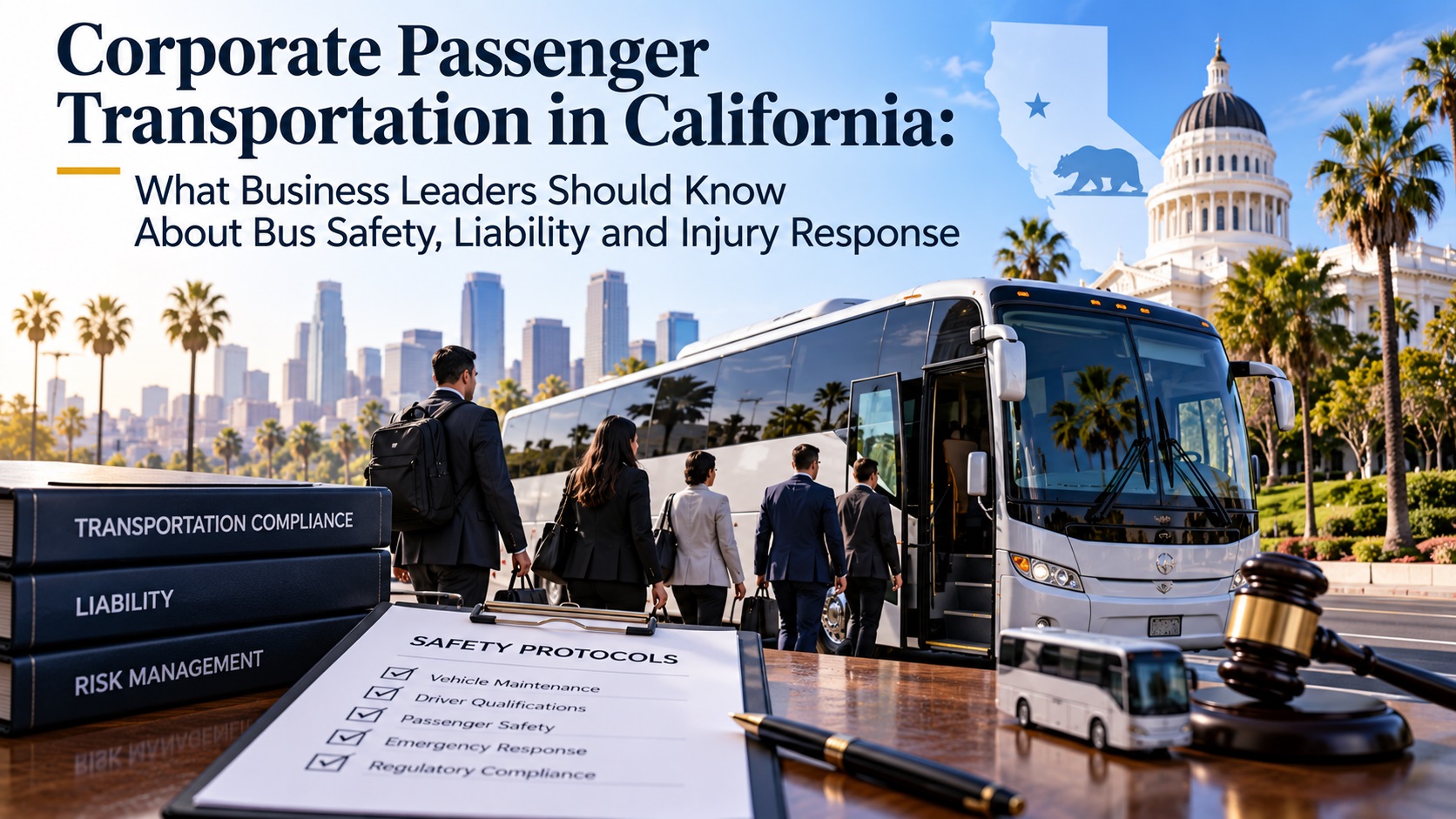

When a California company arranges transportation for employees, conference delegates or other business groups, the decision is often driven by convenience and efficiency. The objective is not to assume responsibility for every action taken by a transportation contractor, but to understand how vendor selection, service arrangements and incident-response procedures can influence the organisation’s exposure and its ability to support passengers when something goes wrong.
Why Passenger Transportation Requires Specialised Vendor Evaluation
Organisations frequently use external transportation providers for employee shuttles, corporate events, off-site meetings and group travel. Procurement personnel therefore need to understand what service is actually being purchased and whether the provider holds the required operating authority. A company’s purchasing department might ordinarily evaluate a supplier through its delivery performance, commercial references and financial terms.
California’s Heightened Duty for Passenger Carriers
California law recognises particular obligations for covered passenger carriers. Civil Code Section 2100 requires a carrier transporting people for compensation to exercise the utmost care and diligence for their safe carriage and to provide what is necessary for that purpose while exercising reasonable skill.
Understanding the Difference Between Operators and Corporate Customers
A company that hires a charter bus is not necessarily subject to precisely the same obligations as the operator providing transportation. Business leaders should therefore seek clarity about who controls transportation decisions and how the parties are expected to cooperate when circumstances change.
Licensing and Insurance Checks Before Signing a Transportation Contract
California’s Public Utilities Commission regulates various commercial passenger transportation services, including relevant charter-party carriers. A corporate customer can incorporate verification into its vendor onboarding process. Rather than relying exclusively on an insurance certificate provided during negotiations, procurement staff should consider confirming the provider’s operating authority and ensuring that the coverage documentation corresponds to the proposed service.
Insurance Limits Should Reflect the Actual Passenger Operation
Passenger capacity can influence applicable minimum coverage requirements. However, compliance with a minimum regulatory requirement does not necessarily establish that a policy is sufficient for every commercial arrangement. Contracts should also clarify which organisation is responsible for arranging required coverage and how information will be exchanged if an incident occurs.
Why Brain Injuries Complicate Passenger Incident Response
One difficult aspect of bus incidents is that the apparent seriousness of an injury immediately after an event may not reflect the passenger’s eventual medical condition. Their presence and severity vary considerably between individuals, and only appropriately qualified medical professionals can evaluate the injury and recommend treatment.
The Business Importance of Medical Follow-Up
Organisations coordinating passenger travel should have a clear process for obtaining emergency assistance and communicating relevant incident information to passengers. In a serious case, an injured passenger may seek legal advice from a riverside brain injury lawyer regarding the circumstances of the incident and any potential civil claim.
Driver Training and the Passenger Experience
Safety considerations extend beyond collisions with other vehicles. A provider’s operating procedures should account for passengers who require additional time or assistance, the appropriate use of designated standing areas where permitted and the handling of unexpected situations during a journey. Corporate customers may also have relevant information to communicate before the service begins.
Contracting for Reliable Transportation Services
A well-prepared transportation agreement should explain the scope of service, the intended route or itinerary, passenger arrangements and the process for handling schedule changes. The contract should also address applicable insurance requirements and identify the appropriate contacts for operational and incident-related communication. A delayed shuttle can interrupt employee shifts, conference schedules or a major corporate event.
Public Transit and Private Charter Services Follow Different Legal Processes
Businesses should distinguish between a privately contracted carrier and a transportation service operated by a public entity. The organisational structure and applicable legal framework can influence how a claim is investigated and pursued following an injury. These procedural requirements are distinct from the ordinary rules governing many private-party injury lawsuits.
Why Identifying the Operator Matters
A shuttle or bus may serve a public institution without necessarily being operated by that institution. Following an incident in Riverside County, legal questions about the operator and potential claims may be examined by a riverside bus accident lawyer.
Preparing for High-Consequence Passenger Injuries
Although many transportation incidents involve relatively limited injuries, some can result in lasting physical or cognitive impairments. Assessing these matters requires appropriate medical, financial and legal expertise. For business leaders, the relevant lesson is to maintain appropriate insurance and incident-management arrangements without assuming that every serious injury will have the same outcome or legal implications.
Communication and Business Continuity After an Incident
A serious bus incident can leave an organisation managing several urgent responsibilities simultaneously. Communications should distinguish confirmed facts from information that remains uncertain. Where medical information is involved, appropriate privacy and confidentiality obligations must be respected. A business should also avoid making premature statements assigning fault or promising that particular expenses will be reimbursed.
Using Passenger Transportation Reviews to Improve Procurement
After a significant incident, organisations may review whether their transportation policies remain suitable. Routine procurement reviews can examine the provider’s current operating authority, the insurance information available, passenger requirements and the effectiveness of communication arrangements. A company operating regular employee shuttles may identify different needs from an organisation arranging an occasional conference charter.
Treating Passenger Safety as an Executive Responsibility
Commercial passenger transportation is often purchased as a supporting service, but the people being transported remain central to the organisation’s activities. Responsible passenger transportation management is not about predicting every possible accident. It is about choosing appropriate providers, understanding relevant obligations and ensuring the organisation is prepared to respond when passenger safety becomes a serious concern.