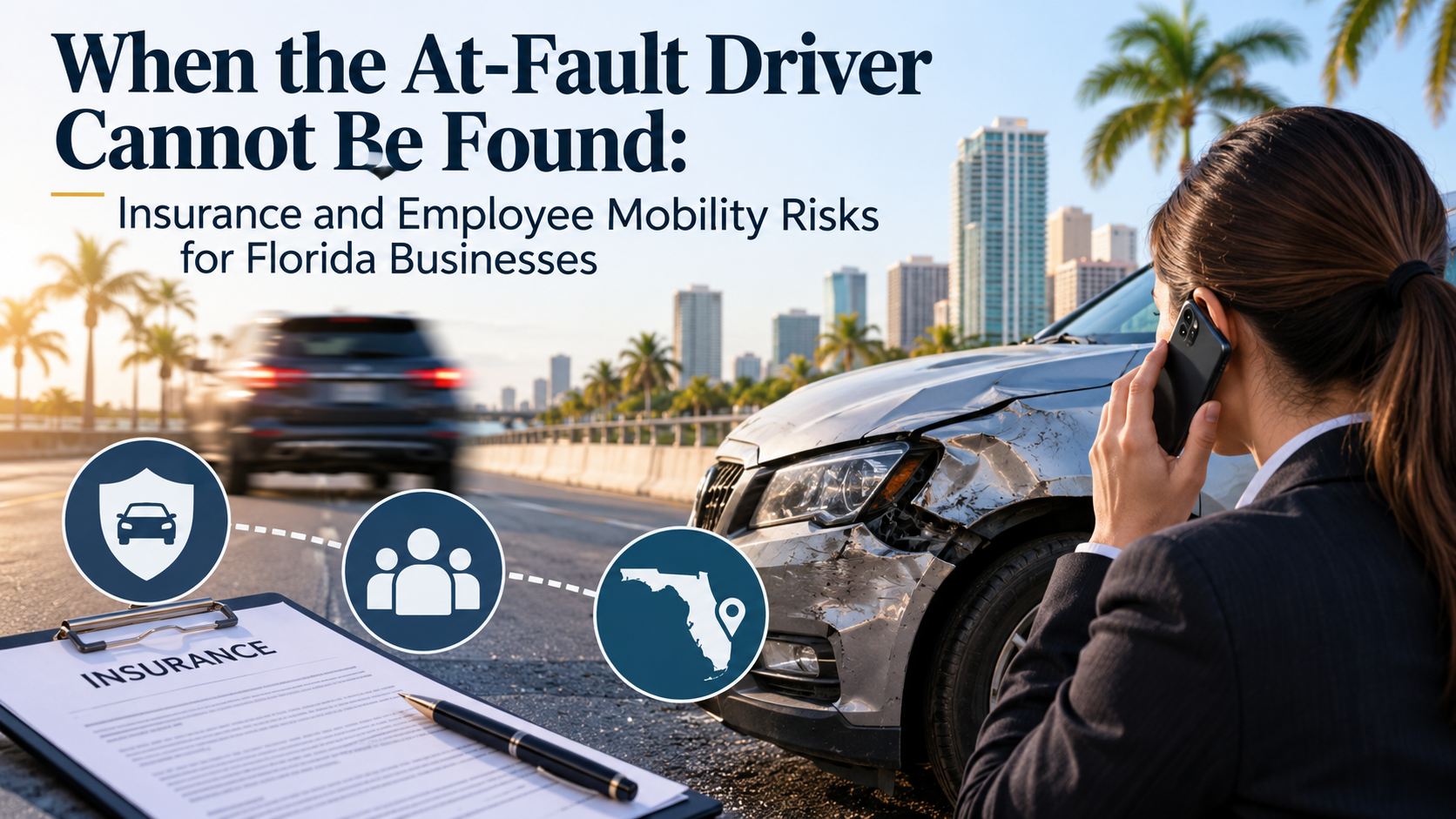

A company’s approach to employee travel is often shaped by practical considerations: who needs to visit customers, which vehicles are available and how much time a journey will take. Although a business is not automatically responsible for every accident involving an employee, organisations benefit from understanding how their travel policies, insurance choices and employee-support procedures interact when an identifiable third-party insurer is unavailable.
The Coverage Problem Created by an Unidentified Driver
Most serious motor vehicle accidents involve an investigation into what happened and which parties may bear legal responsibility. Florida Statutes Section 316.027 requires drivers involved in crashes causing injury or death to stop and meet applicable statutory obligations. Leaving the scene in violation of the provision can carry serious criminal consequences, with the classification depending on the harm involved. For corporate leaders, this distinction changes the insurance question.
Uninsured Motorist Coverage as an Insurance Procurement Decision
Uninsured motorist coverage, commonly abbreviated as UM, is designed to address qualifying bodily injury losses involving an uninsured driver. Florida Statutes Section 627.727 establishes important rules concerning uninsured and underinsured motorist insurance. The law allows a named insured to reject coverage in writing or select lower limits using the prescribed process.
Why a Signed Coverage Decision Deserves Executive Attention
For a growing company, insurance procurement may involve choices made by several people over time. The decision to purchase, reject or limit protection should reflect the organisation’s actual travel arrangements and risk tolerance. For a company that frequently sends employees onto Florida roads, this deserves consideration as part of broader benefits and insurance planning rather than being evaluated only as a line item in the annual insurance budget.
The Hidden Complexity of Employee-Owned Vehicles
Many organisations rely on employees who drive their own vehicles for occasional business purposes. The employer may reimburse mileage without maintaining the vehicle, selecting its insurance coverage or knowing whether the employee has purchased uninsured motorist protection. The relevant policy terms and status of the insured person must be examined. Businesses should consider providing employees with clear guidance about insurance expectations for authorised business travel.
Why Motorcycle Travel Requires Separate Consideration
Motorcycles introduce another coverage distinction that can be overlooked when a company develops a general travel policy. A rider may need legal advice about the interaction between the accident, available insurance and any applicable injury claim. The issues handled by a motorcycle accident lawyer illustrate why motorcycle-related protection should be examined separately rather than assumed to match the coverage available to employees driving cars. A consistent corporate travel policy need not require identical arrangements for every vehicle type, but it should recognise where meaningful differences exist.
Work-Related Travel and Workers’ Compensation Are Not Interchangeable
A common source of misunderstanding is the assumption that an injury involving an employee on the road must automatically qualify for workers’ compensation. Under Section 440.092, injuries suffered while going to or coming from work are generally excluded from compensability, subject to statutory exceptions, including certain special errands or missions.
Workers’ compensation questions, auto insurance coverage and third-party injury claims may require separate review, even when they arise from the same incident.
Supporting an Employee Without Taking Over the Injury Claim
When an employee reports a serious hit-and-run accident, the employer’s immediate concern should be the employee’s safety and access to appropriate assistance. The employer should distinguish between assisting the employee and attempting to control a personal legal claim. Confidential medical information should be handled in accordance with applicable employment and privacy obligations. A personal injury attorney tarpon springs may address the individual’s legal questions while the employer concentrates on employment administration and operational arrangements.
Why the First Records After a Hit-and-Run Matter
An unidentified-driver incident can be difficult to reconstruct because the person allegedly responsible is unavailable to provide an account or insurance details. A business should not encourage employees to alter their accounts, speculate about the identity of a missing driver or attempt to develop an insurance narrative unsupported by the available facts. The precise obligations depend on the insurer, policy language and nature of the claim.
Regional Operations and Insurance Coordination Across Florida
Organisations operating across several Florida communities may face additional administrative challenges when accidents occur far from their main office. Geographical distance should not result in inconsistent employee-support procedures. Where an injured individual requires assistance with an accident claim, a may help examine the relevant insurance arrangements and the circumstances of an unidentified-driver incident. An effective corporate process provides support without confusing administrative assistance with legal representation.
Reviewing Stacked and Non-Stacked UM Arrangements
Another important insurance consideration is the distinction between stacked and non-stacked uninsured motorist coverage. Florida Statutes Section 627.727 permits certain policy arrangements that limit how UM coverage applies across multiple vehicles. These questions are most effectively addressed when coverage is purchased or renewed. Procurement decisions made months earlier can therefore have a substantial influence on the practical options available following an incident.
Turning Insurance Reviews into Better Employee Travel Policies
The purpose of reviewing hit-and-run exposure is not to make employers responsible for every risk encountered by employees on public roads. Rather than creating a lengthy policy that employees rarely read, businesses should establish clear expectations, accessible procedures and an appropriate review process whenever the organisation’s travel arrangements change.
A More Complete View of Corporate Travel Protection
A hit-and-run accident demonstrates a particular vulnerability in road-related insurance arrangements: the person responsible for the harm may never be available to answer a claim. When an at-fault driver disappears, a well-considered insurance and employee-support framework can help an organisation respond with clarity, even when the legal and financial outcome remains uncertain.