
© Copyright Acquisition International 2026 - All Rights Reserved.

Article Image - Business Process Automation in a Nutshell
Posted 21st October 2022

Business Process Automation in a Nutshell

No matter what your organization does, one thing is for sure: it executes hundreds of processes daily. For example, if you work in Finance, there are specific processes related to your market. Moreover, each department inside your organization runs different processes: HR, Customer Success, Sales, Administration, etc. So the question is: are they being done as efficiently as you need them to be?

Mouse Scroll AnimationScroll to keep reading

Let us help promote your business to a wider following.

Business Process Automation in a Nutshell

No matter what your organisation does, one thing is for sure: it executes hundreds of processes daily. For example, if you work in Finance, there are specific processes related to your market. Moreover, each department inside your organisation runs different processes: HR, Customer Success, Sales, Administration, etc. So the question is: are they being done as efficiently as you need them to be?

What is business process automation?

Let’s start by defining what is a “business process”. It’s the series of activities that must happen to achieve your organisation’s objectives. For example: when an employee requests time off from work. First, they usually need to speak to their supervisor, then to the HR department, which needs to be approved or denied. Then, the decision must be communicated to the employee. Now, imagine if you could automate most of those tasks instead of doing them manually.

Business process automation is replacing the manual execution of tasks with a BPM software that automates them for you. It may sound complicated or too “tech,” but it is incredibly simple. For example, a cloud BPM software that is low-code / no-code allows you to model, design, and execute your processes without knowing anything about coding or programming.

How to automate your processes:

Define the process:

What process will you automate first? Once you make this decision, define each task that it involves. It basically means knowing who does what, and in what order.

Model the process:

Once you know the tasks that you need to execute in order to carry on the process, you need to define it visually by creating the workflow needed. Here is an example of the workflow for a reimbursement request process:
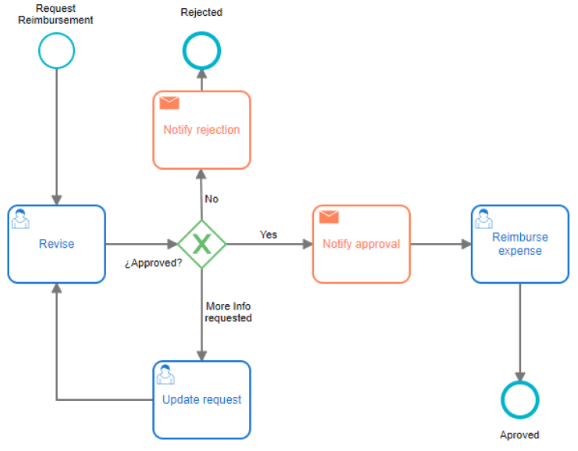
An employee completes a public form detailing what they need to reimburse. An email with the information is sent to the person in charge of revising it. This person has to decide to approve the request, ask for more information, or reject it. Once a decision is made, it automatically sends an email to the employee notifying the decision. If the decision is to reimburse, it creates a task for the employee in charge to carry out this action.

Automate:

After modelling the workflow, the process is ready to go! Just launch it with a simple click and start making decisions.

Monitoring and improving the process:

Make sure everything is running smoothly, and figure out quickly if it has any bottlenecks. You can introduce changes and improvements anytime.

Benefits of business process automation:

Automating your processes means digitalising your organisation, and taking this step results in numerous benefits:

Optimise internal management, and achieve greater productivity and efficiency by automating repetitive tasks. By using BPM software, you can automate tasks that one person previously handled but could actually be done automatically.

Monitoring: By automating your processes, you can access real-time information on each process, providing complete traceability.

Save time and money: By automating processes previously done manually, you save on resources. Stationery and printing, transfers between offices, waiting times, storage, and preservation of paper will no longer be necessary.

Obtain customized reports: Get daily and historical reports. Use the valuable data to evaluate the performance of your processes and make the necessary decisions with agility, without the need for analytical tools.

Be scalable: You can be sure that every one of your processes will execute as you planned them. Moreover, integrations between systems reduce human errors. Let your team focus on the tasks they really need to execute and not on repetitive tasks that can be automated.

Now is the time to digitalise your organisation. As you have learned, starting by automating your business processes is a simple and beneficial place to start!


Categories: Innovation, News


You Might Also Like
Read Full PostRead - Eye Icon
How to Maximise Hotel Revenue Through Strategic Pricing
News
26/07/2024How to Maximise Hotel Revenue Through Strategic Pricing

Maximising hotel revenue involves more than just setting competitive rates. It requires strategic pricing that adapts to market conditions, guest preferences, and emerging trends.

Read Full PostRead - Eye Icon
K&E & Skadden Among Five Firms on 58.com’s Stake Acquisition in Ganji
M&A
07/05/2015K&E & Skadden Among Five Firms on 58.com’s Stake Acquisition in Ganji

K&E & Skadden Among Five Firms on 58.com’s Stake Acquisition in Ganji

Read Full PostRead - Eye Icon
The Influence of Digital Footprints on Business Reputation and Trust
News
25/02/2025The Influence of Digital Footprints on Business Reputation and Trust

Although the internet creates new opportunities to reach consumers, it also introduces complications.

Read Full PostRead - Eye Icon
4 Things You Should Know About The IoT Industry
Innovation
22/08/20224 Things You Should Know About The IoT Industry

Have you ever used your smartphone to turn on the air conditioner in your home? Or have you used a step counter to measure your daily walking distance? If so, then you’ve already had first-hand experience with IoT. IoT stands for Internet of Things, a term r

Read Full PostRead - Eye Icon
Business Valuations – IBG Business
Finance
31/08/2016Business Valuations – IBG Business

IBG Business is a highly renowned leader in business sales and acquisitions of privately held lower middle-market companies.

Read Full PostRead - Eye Icon
Why Small Businesses Should Diversify Their Payment Options
Finance
12/05/2021Why Small Businesses Should Diversify Their Payment Options

Payment options are one aspect of your business that can greatly affect your customers, operations, and profits. The impact of diversifying your business’ payment options goes beyond the ordering and checkout process; it can significantly benefit your busine

Read Full PostRead - Eye Icon
Cloud-Based Management Systems Designed to Inspire and Empower
Innovation
07/08/2024Cloud-Based Management Systems Designed to Inspire and Empower

Enabling organisations through its suite of pioneering management systems, IQMS Australasia, offers a highly refreshing approach when it comes to management solutions.

Read Full PostRead - Eye Icon
GDPR: What you need to know
Finance
28/03/2018GDPR: What you need to know

From 25 May 2018 the Data Protection Act 1998 (DPA) will be replaced by The General Data Protection Regulation (GDPR), and it will bring important changes to the ways data is stored and processed by businesses.

Read Full PostRead - Eye Icon
Bridgepoint Developement Capital acquisition of stake in MVF
Finance
04/08/2015Bridgepoint Developement Capital acquisition of stake in MVF

Bridgepoint Developement Capital acquisition of stake in MVF


Our Trusted Brands

Acquisition International is a flagship brand of AI Global Media. AI Global Media is a B2B enterprise and are committed to creating engaging content allowing businesses to market their services to a larger global audience. We have a number of unique brands, each of which serves a specific industry or region. Each brand covers the latest news in its sector and publishes a digital magazine and newsletter which is read by a global audience.

Arrow