
A construction project can be commercially successful on paper yet create serious problems if the space surrounding the development is poorly managed. A decision about where to position a loading gate may influence pedestrian movement, delivery efficiency and the safety of workers carrying materials. Managing these issues effectively requires early planning, clear contractor responsibilities and continuous attention as site conditions evolve.
Why the Construction Boundary Is a Management Responsibility
A construction fence creates a visible separation between an active worksite and its surroundings, but it does not eliminate the interaction between the two. These conditions make the construction boundary an important element of project management. Developers need to consider how the surrounding environment will function throughout different construction phases, not simply how the completed building will operate.
Planning the Site’s Public Interface Before Work Begins
During preconstruction planning, project teams should identify pedestrian routes, vehicle entrances, delivery locations, adjacent businesses and any areas where construction activities could temporarily affect public access. Resolving these questions before mobilisation generally provides more options than attempting to redesign access after several subcontractors have already begun work.
Coordinating Construction Logistics with Boston’s Public Space Requirements
Urban construction frequently requires coordination with local authorities, particularly when contractors need to restrict access to part of a street or sidewalk. For developers and project managers, permit preparation should therefore be incorporated into the overall construction schedule rather than treated as an administrative task immediately before equipment arrives.
Managing Deliveries Without Disrupting the Surrounding Area
Delivery planning is particularly important where construction sites share limited road space with commercial traffic and pedestrians. A practical logistics schedule should identify suitable delivery periods, vehicle-size restrictions, waiting arrangements and the individuals authorised to coordinate entry. Drivers should receive clear instructions before arriving, while personnel responsible for vehicle movements should understand the relevant traffic-control arrangements.
Worker Safety When Construction Conditions Change
The safety of construction workers remains a fundamental management concern, particularly when tasks involve elevated working platforms, ladders, scaffolds and exposed edges. Under 29 CFR 1926.501(b)(1), for example, employees working near unprotected sides or edges six feet or more above a lower level generally require an appropriate fall-protection system.
Connecting Safety Decisions with Construction Scheduling
Safety arrangements should be considered whenever a project’s sequencing changes. When a serious incident occurs, questions about access to safe equipment, the condition of protective systems and responsibility for the work area can become central to a legal investigation. Such matters are among the issues that may be examined by a Boston construction site fall lawyer when assessing the circumstances of an injury.
Understanding Responsibility on Multi-Contractor Projects
Commercial construction projects commonly involve a general contractor and several specialist subcontractors working within the same environment. Their activities may overlap, particularly where structural work, electrical installation, material deliveries and finishing operations proceed simultaneously. OSHA’s multi-employer citation policy recognises that, depending on the facts, more than one employer may be cited for a hazardous condition.
Why Clear Contractor Responsibilities Matter
Project agreements and site procedures should explain who coordinates shared work areas, communicates changes and addresses identified hazards. Businesses confronting those questions may seek guidance from boston construction accident lawyers to understand how a particular injury claim could involve multiple parties. Contractual language is important, but it does not automatically eliminate responsibilities imposed by law.
Designing Pedestrian Access Around an Active Construction Site
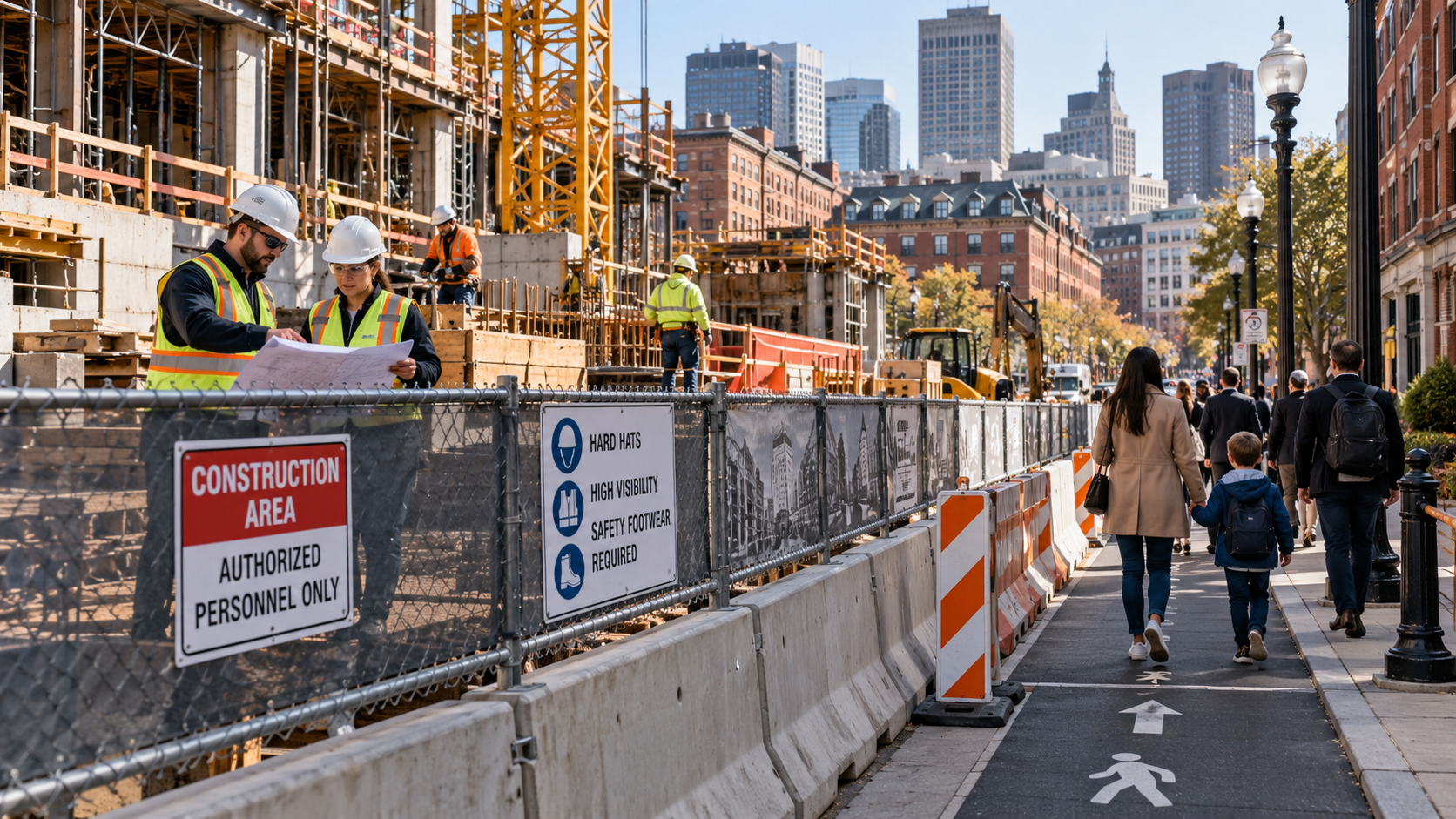
A construction project can affect pedestrian movement even when the building work itself remains fully contained. For developers, the objective should be to maintain an understandable and appropriately protected route around the work wherever required by the applicable traffic-management arrangements.
Construction Entrances and Crosswalk Safety
A particular concern arises when heavy vehicles enter or leave a site close to a pedestrian crossing. Massachusetts General Laws Chapter 89, Section 11 establishes duties for drivers concerning pedestrians in marked crosswalks in circumstances where traffic signals are absent or not operating. Construction-related changes to pedestrian routes can create additional questions about visibility, signage and the conduct of different parties.
Protecting Relationships with Neighboring Businesses
An urban development project rarely operates in isolation. Developers should therefore consider communication with neighboring businesses as part of their project coordination responsibilities. A clear point of contact is also useful when an issue requires immediate attention, particularly where several contractors are working on the development and neighboring businesses may otherwise be unsure whom to approach.
Making Site Inspections Responsive to Daily Conditions
Construction sites evolve continuously, and arrangements that were appropriate during one phase may need revision during another. Observations should lead to timely decisions when conditions require adjustment. Developers and contractors should also establish a method for communicating changes across the affected teams so that a modification made for one activity does not unintentionally interfere with another.
Integrating Public Safety into Project Cost and Schedule Decisions
Construction managers operate under commercial pressure to deliver projects within agreed budgets and deadlines. Effective budgeting should therefore recognise temporary traffic and pedestrian arrangements as legitimate project requirements. Their cost, timing and responsibilities should be evaluated during procurement and scheduling, particularly for constrained sites where access conditions are likely to affect several phases of construction.
A Broader Standard for Successful Urban Development
The successful delivery of an urban construction project depends on more than completing the building itself. Developers and contractors must also manage the temporary environment created during construction, including the interactions between workers, vehicles, pedestrians and neighboring businesses. Boston’s dense commercial environment makes these interactions especially important. For business leaders, construction-site safety should be understood as part of project delivery rather than a separate activity delegated entirely to individual contractors.