

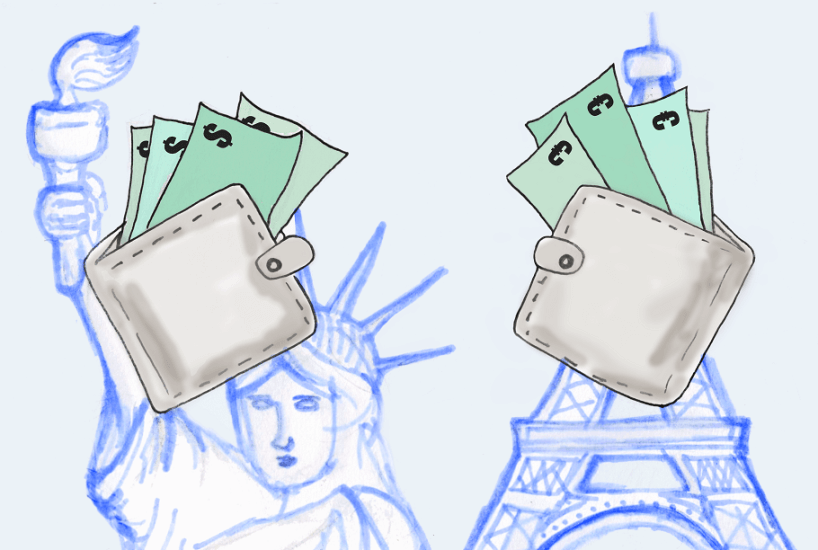
A Tale of Two Wallets
Read this month’s CPD Accredited Article to gain CPD Points, in which Phil Davies, Managing Director of PSI-Pay gives his personal perspective on American vs European payment ‘wallet’ models.
Wallets, or purses, have been around since bartering was replaced by the exchange of goods for currency of whatever variety. Therefore, they were handy means of carrying that currency in case you needed to ‘buy’ something on your travels. Centuries, if not millennia, have passed and we are now in the electronic, or digital, age. The wallet and/or purse are still with us albeit with that all important prefix the ‘E.’ There are a plethora of ‘E’ wallets these days all offering the provision of various beneficial attributes, depending on the requirements of the user but the fundamental reason for being remains much the same.
For the purposes of this article I will, briefly, examine just two basic models, comparing and contrasting the differences and why payment professionals should be aware of them.
1: The “American” The first, which I am terming the American, model works primarily on the basis that someone wishes to buy goods online.
This model, unsurprisingly, is suited to the American payment culture and transactions are, literally, like for like. This is used for account discretion, security and may also embody a loyalty program. There is no element of stored value and transactions are fully card based and so it may be possible for chargebacks to be passed through, dependent on circumstances.
So having decided I’m going to buy something online and flag that with the merchant I will be presented with, typically, a number of payment options which will usually include a wallet alongside the usual payment card options. If I choose to pay by the wallet option, assuming I already hold an account, then the payment I have committed to is cleared and settled via the wallet operator using my predetermined deposit option. Should that deposit, or load, option be a payment card then it is easy for the scheme, and its associated issuer and acquirers, to identify the beneficiary of the funds and have the transaction coded in the most appropriate way since the funds are ‘passed through’ for an end to end transaction, in simple terms anyway.
There are many organisations operating wallets of this type, including the card schemes themselves. All well and good so far then.
2. The “European” Now we come to the second, which I’m terming the European, type of wallet. Catering for the many different payment cultures in Europe and feature many and varied forms of load of which cards may be one option.
One of the reasons that most of this type of wallet have payment cards attached to them so that a broader range of merchants can be reached and facilities, such as ATM’s, can be accessed.
Again this model is used where financial and account discretion and security is desired but this model also, invariably, incorporates a stored value element, including multi-currency capability. Because the load is used to complete a purchase of ‘electronic’ money any chargeback liability must stop with the wallet operator.
This type of wallet works in much the same way as a bank current account, the fundamental differences are that E money accounts are not allowed to offer credit so no overdraft. They are also not allowed to allow interest to accrue on outstanding account balances, although there are ways to reward those situations. The most noticeable difference, which is not entirely apparent, is that bank accounts are safeguarded under EU deposit protection schemes up to a specified limit (£75k in the UK, for example). Electronic money is not covered under these compensation schemes but are subject to even greater security stringencies in that 100% of funds must be ring-fenced in compliant safeguarded client accounts which have no financial limits imposed.
So it is these ‘wallets’ that have funds deposited in the aforementioned safeguarded accounts that must have those funds deposited, or loaded, before any further transaction can take place. With this type of ‘wallet’ a number of different types of transactions can occur, in much the same way as a bank current account does as mentioned previously, usually including the use of a payment card to access the funds contained therein.
It is clear, therefore, that the beneficiary of the funds is the ‘wallet’ operator as funds are stored for future transactions or future multiple transactions. If the funds are deposited/loaded using a payment card then the transaction coding should always be of a financial services nature since the customer is, at this point, purchasing ‘electronic money.’
The customer now has the wherewithal to conduct transactions, at their leisure, as if it were a current account, in fact there is an increasing number of individuals, and SME businesses, that are choosing to use these accounts instead of, or in addition to, bank current accounts. I have, perhaps, laboured the point here but the purpose of this is to highlight the fact that some card schemes are trying to force the second model, as described, to fit the first type of model which just isn’t realistic, or accurate. My contention, therefore, is that we should have a category of ‘digital account’ for the second model and definitions applied accordingly thus giving full transparency and accuracy.
So perhaps the question to ask should be: Q. “When is a wallet not a wallet?” A. “When it’s a digital account!”
Phil Davies is the Managing Director of PSI-Pay Ltd. Prior to heading up PSI-Pay, spent eight years with MasterCard Worldwide as Vice President-Business Development. There he was responsible for implementing new initiatives designed to encompass new products, technology and strategic partnership to stimulate growth in emerging markets throughout Europe.
For further information on the CPD Certification Service please visit their website, here.
Company: PSI-Pay
Name: Phil Davies
Email: contact@psipay.com
Web: www.psi-pay.co.uk
Address: Afon Building,
Worthing Road, Horsham,
West Sussex, RH12 1TL, UK
Phone: 44 (0)1403 788 340